

The best time for switching payroll providers is early April each year. That’s when the new tax year kicks off, and it’s the cleanest moment to move. Lots of UK firms keep putting it off, mostly because they dread a late payday or a nasty error. One wrong move can hold up wages or land you an HMRC fine within days. But a move that’s planned properly? Your staff gets paid, your records stay tidy, and nobody loses confidence in you.
Below, we walk through the whole thing in plain steps for UK businesses. We’ve also covered a few gaps that most guides on this topic quietly skip. At Eco Outsourcing, we help businesses switch payroll providers every single week. Our team handles all your work so you can focus on growth.
What Is Payroll and How Does It Work?
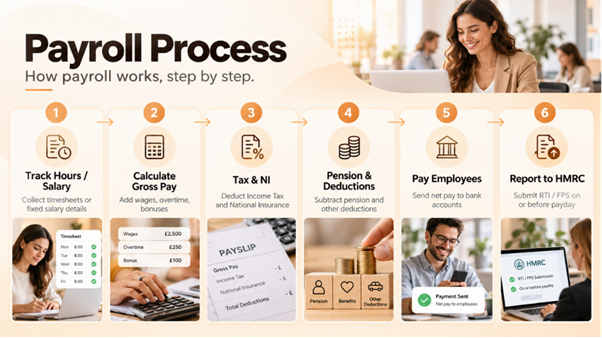
Payroll means paying people for the work they’ve done. That means wages, tax, deductions, and benefits, run weekly, every two weeks, or monthly, depending on your policy. The schedule is up to you. The accuracy isn’t. UK law wants the right amount, paid on time, every time. Here’s how a normal payroll run goes from start to finish:
Step 1: Track Employee Hours or Salary
Begin with what each person has earned for the period. For hourly staff, that means timesheets. It is a fixed figure for salaried staff. Always examine extra time and commission payments for accuracy.
Step 2: Choose and Check the New Provider
Pick a provider that suits the size of your business. They must know UK payroll well. Ask them for a demo. Then ask how they will move your payroll across.
Step 3: Give Notice to Your Old Provider
Use written communication and adhere to the deadlines in your agreement. Request that they continue processing payroll until the replacement company is up and running.
Step 4: Share Data and Records
It is always advisable to start planning for payroll data migration early because it usually takes more time than anticipated to verify the data. Always ask the previous company to provide all files.
Step 5: Run a Parallel Test
Run both systems together for at least one full pay cycle. Compare the payslips carefully and resolve any issues clearly before go-live.
Step 6: Go Live and Tell Your Staff
Tell your team about the new payday and how their payslips will be delivered to them. An advance notice at the beginning can save you lots of questions.
Why Do Businesses Switch Payroll Providers in the UK?
Most firms decide to switch payroll providers after one costly mistake happens. Here are the top reasons we see each other again.
- Mistakes keep happening, and HMRC deadlines get missed, which wears down trust fast.
- Fees go up. The service doesn’t, or it actually gets worse.
- Support waits days to provide answers to questions that should take minutes.
- The business is expanding, and it requires more advanced tools for a larger staff and complex pay calculations.
- You won’t be able to use their old software with your accounting or HR software.
What Is the Best Time to Switch Payroll Providers in the UK?
The best time to switch payroll providers is early April each year. The UK tax year starts on 6 April and ends on 5 April. Review the table below to compare each switching time and its key benefits:
| Timing Option | Good Points | Watch Outs | Best For |
| Start of tax year (6 April) | Clean records and no year-to-date data | Busy time for all providers | Firms that can plan ahead |
| Quarter end | Easy reports and clear cut-off | Needs some year-to-date data | Growing small firms |
| Mid year | Fixes problems right now | Needs careful data checks | Firms with urgent issues |
Can You Switch Payroll Provider Mid-Year in the UK?
You can, and at pretty much any point. The one condition is that year-to-date totals get loaded first. We see plenty of firms change provider mid-cycle just to get away from bad service, and that’s a perfectly good reason. Be extra careful with tax and pension records, though, because that’s where mid-year switches tend to go wrong.
When Should You Avoid a Payroll Move?
Steer clear of the last month of the tax year if you can. Year-end work is already stacking up, with P60 forms due by 31 May. Bonus months and pension re-enrolment dates also add extra pressure to any move.
What to Review Before Changing Your Payroll Service Provider?
A good payroll provider in the UK begins with a concise list of needs. Adhere to important key points to check before Switching Payroll Providers
- Review your old contract and see when you may be able to move out.
- Buy the whole price and look out for any additional fees.
- Compare payroll provider integration in the UK with accounting and HR software.
- Ensure they are cooperating with HMRC and have a proper understanding of what the rules are in the UK for payroll.
- Knowing how quickly that support will respond and if they will give you a one name contact.
Reviews help too, and so does asking for UK clients of a similar size to yours. This table is a handy way to compare providers:
| What to Compare | Question to Ask | Why It Matters |
| Price | What is the full monthly setup cost? | No surprise bills later |
| Support | How fast do you reply to questions? | Faster fixes for pay issues |
| Integration | Which accounting and HR tools link with you? | Less typing and fewer errors |
| Security | Do you hold ISO 27001 or similar proof? | Safer staff data |
| UK Rules | Do you file to HMRC for me? | Fewer fines and late notices |
How Do You Switch Payroll Providers Step by Step?
Here is the full route to change payroll providers UK employers can trust. Keep this switching payroll providers checklist close while you work through it:
Step 1: Review Your Current Payroll Setup
Write down every pay group, pension scheme, and benefit you’re running right now. All the other items on your checklist for changing your payroll provider depend on this list.
Step 2: Choose and Check the New Provider
Choose a company that has extensive experience in dealing with companies like yours and knows all about UK pay regulations.
Step 3: Inform Your Current Provider
Make sure to inform your current company of the fact that you’ll be switching to another provider. Walk through your contract and find out how much notice you have to give them.
Step 4: Ensure Data Transfer
Commence the data transfer process promptly. Paperwork takes longer than expected. Request that copies of all documents be provided to you by your previous provider.
Step 5: Test Both Systems
Run both systems simultaneously for at least one complete payroll period. Compare the pay slips and solve any small problems before proceeding.
Step 6: Inform Your Employees
Tell your staff about the payroll process and how they will be able to receive their pay slips. It is better to inform your employees in advance so that no problems arise.
Step 7: Check the First Pay Run
Look closely at net pay, tax and NI on the first live payslips. And make sure your HMRC reports were sent before that first payday.
What Information Is Needed for Payroll Migration in the UK?
Payroll migration is straightforward if your records are ready to go. Gather this together before your new provider asks:
- YTD Pay, Tax and NI for each employee.
- Full names, NI numbers, tax codes and bank information.
- Pension scheme details, contribution rates and anyone who’s opted out.
- Any sick pay, maternity pay or other statutory pay that’s still running.
- Starter/leaver forms and your PAYE reference and HMRC login.
- Payroll records must be retained for 3 years according to UK law.
What Payroll Data Do You Need to Migrate?
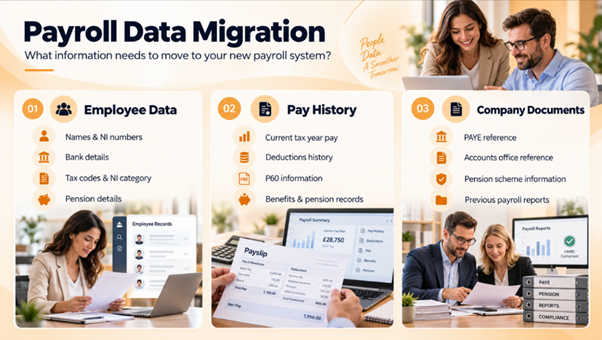
Employee master data is the starting point: names, NI numbers and bank details. Then there’s pay history for the current tax year, showing earnings and deductions. Tax codes and NI categories have to move across accurately as well, and pension scheme details and contribution rates need a careful hand.
Which Historical Payroll Records Are Needed?
Pay history for the current tax year is the main one. Last year’s P60 details help later when tax codes get calculated. Benefits and deductions data keeps things consistent for everyone, and your pension contribution records show you’ve stayed within auto-enrolment rules.
Which Company Documents Need to Be Shared?
Your PAYE reference tells HMRC who you are. The accounts office reference connects payroll submissions to your tax account. Pension scheme details show how you’re registered and what gets paid in. Past payroll reports are useful too, since they show the new provider how you pay people.
How Long Does the Payroll Provider Transition Timeline Take?
Expect a payroll provider timeline of 4 to 8 weeks depending on how complex things are. A small firm with a handful of staff might finish in about 3 weeks. Bigger firms with lots of pay groups could need 12 weeks or longer:
| Week | Task | Who Leads |
| Week 1 | Pick provider and send notice | You |
| Weeks 2 to 3 | Share records and set up systems | Both providers |
| Weeks 4 to 5 | Run parallel payroll test | New provider |
| Weeks 6 to 8 | Go live and check first pay run | Both providers |
What Slows Down a Payroll Move?
- Data that arrives late from the old provider is the number one culprit.
- Missing tax codes or incorrect bank details can push your go-live back too.
How Can You Switch Payroll Providers Without Disrupting Pay?
A good handover means people get paid on the right day, full stop. A few habits help:
- Keep pay dates unchanged during the move, where possible.
- Run both systems side by side until the figures match, every time.
- Check bank details early. One wrong digit can hold up someone’s pay for days.
- Give staff a single person to contact about pay while the switch is happening.
Will Switching Pension Providers Disrupt Payroll?
It can, particularly if contribution files or rates change. Your payroll has to send the correct amounts to the new scheme on time. If you can, don’t change pension provider and payroll provider on the same date.
What Are the Payroll Provider Switching Costs?
The price depends on the size of your business and the particular service that you choose. Some small businesses charge from £4 to £15 per person per month.
- Some companies may have setup or migration charges, so inquire about any fees before entering into a contract.
- The provider of your existing services may also charge fees for early termination and require the cost of the notice period to be settled.
- The cost of staff time spent on testing and data checks is not one that people remember.
- HMRC late filing penalties are charged at £100 a month for 1 to 9 employees.
How Do You Stay Compliant When Switching Payroll Providers?
Staying compliant just means you keep meeting every HMRC rule and deadline while the move happens:
- Send your Full Payment Submission to HMRC on payday or before it.
- Make PAYE and NI payments to HMRC on the 22nd of every month.
- Maintain accurate year-to-date numbers in order to facilitate proper tax code operation.
- Make sure that pension enrolment or statutory pay rules don’t slip by the wayside in the transition.
- Register your new provider with HMRC for them to register on your behalf.
How Do You Maintain Payroll Compliance During the Switch?
Have your old provider send the final payroll reports to HMRC first. After that, update your employer reference details with the new one. Check that every employee’s tax code carries over before the first pay run, and make sure RTI submissions switch over on the correct payment dates.
Which HMRC Notifications Are Required?
They will need to register as your payroll software with HMRC. Employer Reference details are updated to ensure they are submitted to the right account. The old provider’s last submission is the end of the last provider, and the new provider’s first submission is the beginning of the new provider.
How Do You Maintain Pension Auto-Enrolment During the Switch?
Agree scheme transfer dates with your pension provider directly. Make sure no contribution gets missed along the way. Keep track of re-enrolment dates for eligible staff and meet the reporting requirements for any pension scheme changes.
Is Your Data Safe During a Payroll Provider Move?
Payroll files are full of personal details, so payroll provider data security really matters. It is the job of UK entities to make sure that this information is safe in accordance with GDPR and Data Protection Act regulations.
- Ask if the provider holds a recognized security badge like ISO 27001.
- Send files only through safe and locked channels and never by email.
- Check who can see payroll data and how that access is tracked.
- Ask what happens to your old data once the move is done.
What GDPR Rules Should You Consider?
Sign data transfer agreements between your old and new providers. Check what employee consent is needed before sharing data. Look at your retention policy for historical payroll records, and update your privacy notices so they name the new payroll processor.
Frequently Asked Questions
It can, if it isn’t coordinated with your payroll team. Auto-enrolment duties have to continue without any gap. Plan both switches together so you don’t end up doing the work twice or making errors.
6 April each year is the best time. It provides you with a fresh start for each payroll. Switches can also be done in mid-year, but require additional planning and data imports.
Conduct parallel payroll testing on both systems prior to full conversion. Notify staff 2 weeks in advance of the change. Have overlapping payment processing so that no one is paid less than they should be.
Read through your current contract terms and notice period before signing anything new. Then check the new provider’s HMRC recognition status and their GDPR compliance.
You will need important things such as employee NI numbers and current tax codes. Include up-to-date pay history, plus last year’s P60. Provide your PAYE reference and details of your pension scheme.
Yes. There are a couple more steps to track tax code and NI for mid-year changes, and data will have to be imported for previous pay periods this tax year.
The whole process of most switches takes 4 to 8 weeks to complete. It can be done in four weeks for small businesses with fewer than 50 employees.
Final Thoughts
Moving payroll does not need to feel like a big and risky project. Choose early April or a month’s end and follow the 7-step checklist. Gather your records and run a parallel test before you go live. However, Professional support reduces errors and keeps employee pay on track.
This is exactly where Eco Outsourcing has helped UK firms make this move with no missed paydays. Our payroll experts handle data checks, HMRC reports, and staff updates. Book your free session with Eco Outsourcing and start with total confidence.