
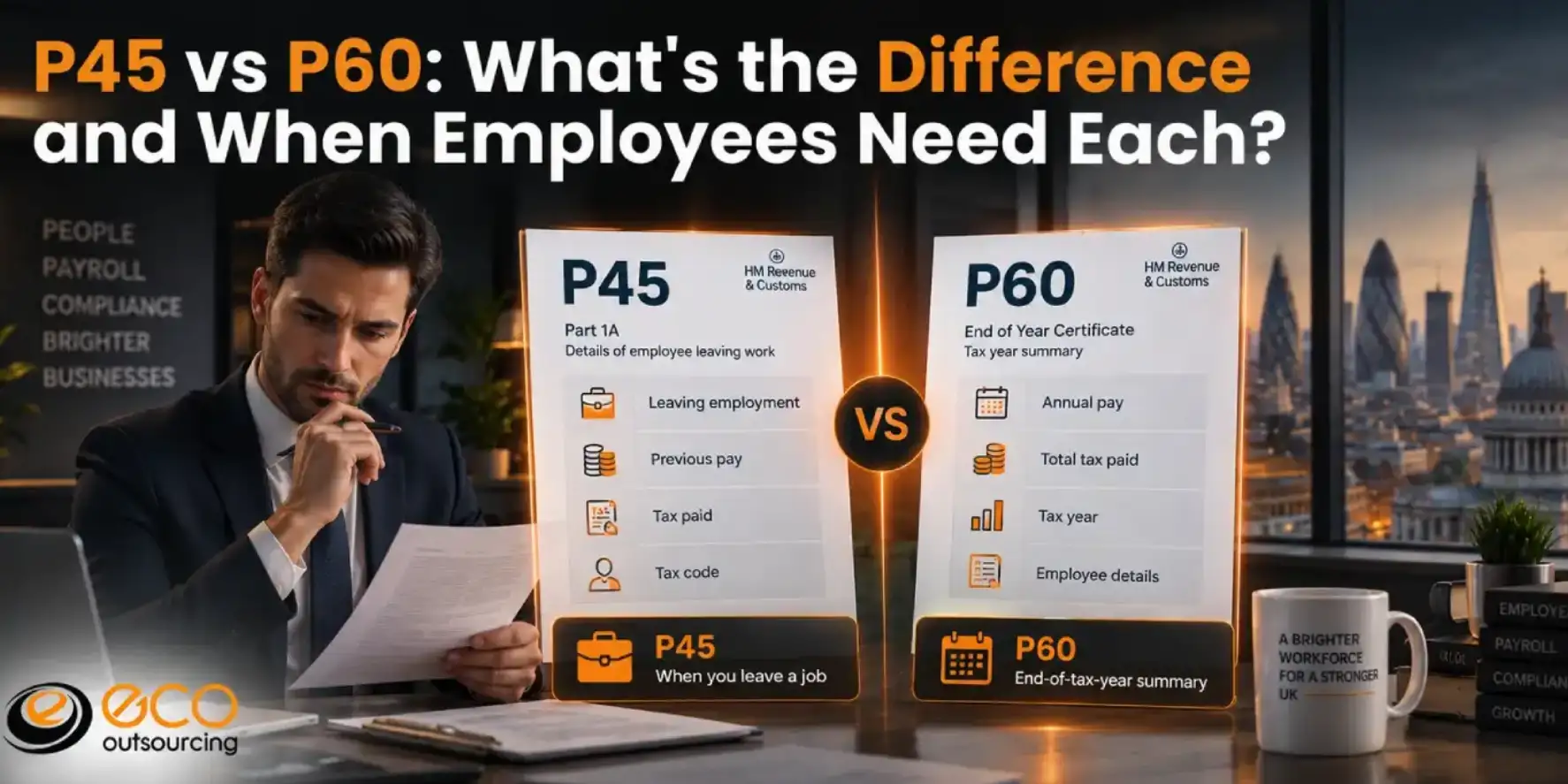
A P45 and a P60 are both PAYE records, but they are issued at different times and used for different purposes:
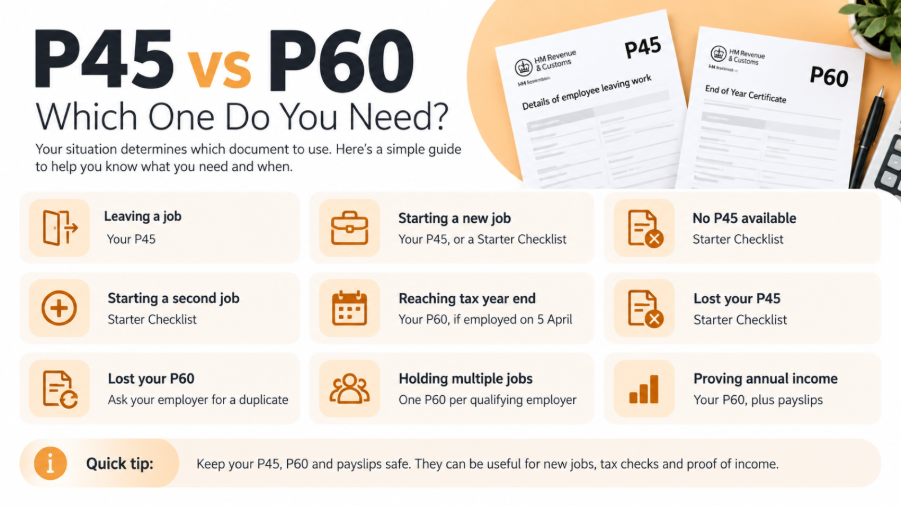
- P45 when you leave a job: Your employer issues it after your employment ends. Give it to your new employer so payroll can carry forward your pay and tax details and apply the appropriate tax code, a process our UK payroll management service handles as part of every new starter setup.
- P60 at the end of the tax year: Your employer issues it if you are still employed on 5 April. It summarises the pay and tax recorded for that employment during the tax year.
Starting a new job? Give your new employer your P45, not your P60. If you do not have a P45, complete HMRC’s Starter Checklist instead.
What Is a P45?
A P45 certificate in the UK shows what you earned and paid in tax in one job, from 6 April to your leaving date.
What Information Is on a P45?
Your name and National Insurance number, your employer’s PAYE reference, leaving date, tax code, and total pay and tax for that job.
What Are the Different Parts of a P45?
A P45 has four parts. Part 1 goes to HMRC from payroll. Part 1A is yours to keep. Parts 2 and 3 go to your new employer, or the Jobcentre for benefits claims.
When is a P45 Issued?
Whenever employment ends, through resignation, dismissal, redundancy, or a contract finishing. Your employer should give you one once final pay is calculated, usually with your last payslip.
What Is a P60?
What Information Does a P60 Show?
A P60 certificate in the UK is your annual record of pay, tax, and National Insurance for one employment, covering the full tax year.
When Is a P60 Issued?
The rule centres on 5 April. If you’re employed that day, your employer must give you a P60 by 31 May, on paper or electronically, even if you’re on leave.
Does Every Employee Get a P60?
Not everyone. When a P60 is issued depends on whether you’re still with that employer on 5 April. Leave before then, and you get a P45 instead. Hold two jobs at once, and both owe you a P60.
Do You Give a New Employer Your P45 or P60?
Give your new employer your P45. Payroll uses it to set your tax code and carry over pay and tax figures. A P60 only covers a completed year with a previous employer and tells your new employer nothing about your current position.
Can You Use a P60 Instead of a P45?
No. A P60 confirms last year’s totals, not this job’s pay and tax. Without a P45, your correct next step is the Starter Checklist.
Starting a New Job Without a P45
Common reasons: your P45 for your new employer hasn’t arrived, it’s lost, or your previous employer is slow. It’s also normal for a first job or an extra one.
What Is the HMRC Starter Checklist?
The Starter Checklist replaced the old P46 form. New starters complete it when they can’t hand over a valid P45. It asks whether this is your only job and gives payroll what it needs to set a tax code and report you through the FPS; a setup step covered in our guide to managing payroll for small businesses.
Does No P45 Automatically Mean Emergency Tax?
Not necessarily. A completed Starter Checklist usually lets payroll apply a reasonable code straight away. Only with no P45 and no checklist does an employer typically fall back on an emergency code. Check that your p45 emergency tax situation isn’t lingering longer than it should.
What Happens If Your P45 Arrives After Your First Payday?
If your P45 arrives after payroll has already processed your first payday, the process usually works as follows:
- You start the job without a P45.
- Payroll uses the information from your Starter Checklist for the first pay run.
- Your employer submits the first Full Payment Submission (FPS) to HMRC.
- Your P45 arrives after that submission.
- Payroll checks whether HMRC has already issued a tax code notice.
If not, current guidance says payroll uses the tax code from Parts 2 and 3 of the late P45 going forward, without adding the earlier pay and tax figures unless HMRC confirms them directly.
Check your next payslip to confirm the update was applied.
Can payroll still use a late P45? Generally, yes, for the tax code. A new start date isn’t reported. If HMRC has already issued its own code, that instruction usually takes priority, which is why choosing a provider that handles P6 and P9 tax code notices correctly matters so much.
Why Am I Still on Emergency Tax After Giving My P45?
There’s no single cause. Reasons include a P45 arriving after payroll had already run, HMRC issuing a later code that overrides it, your previous job still showing as active, or wrong Starter Checklist details.
What Should You Check First?
Compare the tax code on your payslip against your P45. Then check your HMRC Personal Tax Account or app, which shows employment records and coding notices sent to your employer.
Should You Contact Payroll or HMRC?
| Issue | Start here |
| Payslip code doesn’t match your P45 | Current payroll |
| P45 details look wrong | Previous employer |
| HMRC shows incorrect employment | HMRC |
| Coding notice hasn’t reached payroll | HMRC, then confirm with payroll |
What If Your Employer Has Not Given You a P45?
Your former employer must provide a P45 once final pay is calculated. A short delay around a busy payroll run is normal, but weeks of silence isn’t. Ask them directly first.
Can You Get a Replacement P45?
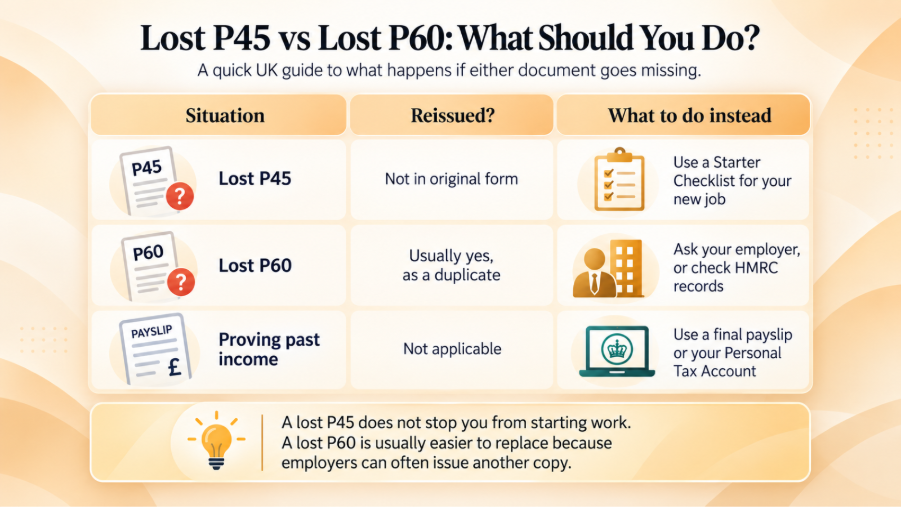
No, not in its original form. A P45 replacement in the UK isn’t possible once issued, since HMRC’s system doesn’t allow the same allowance to be applied twice. Starting a job without one? Complete a Starter Checklist instead. Meanwhile, check your HMRC Personal Tax Account for pay and tax history, and keep any final payslips, since secure records like these fall under the same data protection duties that apply to employee documentation more broadly.
What If Your Employer Has Not Given You a P60?
Anyone employed on 5 April should have a P60 by 31 May. Missing that deadline is a payroll matter, separate from a P45 problem, so contact payroll directly.
Can You Get a Replacement P60?
Yes, and a P60 replacement in the UK differs sharply from a P45. Employers can usually reissue a duplicate, often marked as such. If they genuinely can’t help, HMRC’s own records serve the same purpose.
What If You Lost Access to Your Old Payroll Portal?
Ask your former payroll or HR team to reissue it by post or email. If the portal is gone entirely, your Personal Tax Account still holds the figures. Save important payroll documents outside any one portal.
What If Your P45 Is Wrong?
Wrong Pay or Tax
Compare it against your final payslip. If it doesn’t match, contact your previous employer. HMRC only gets involved once the employer confirms an error.
Wrong Leaving Date
This can leave old employment looking active on HMRC’s system, sometimes overlapping with a new job. It doesn’t automatically cause a tax problem, but flag it so the FPS record can be corrected.
Wrong Personal Information
Check your name, National Insurance number, and address. Ask your previous employer for a corrected version.
Wrong Tax Code
There’s a difference between the code on your P45, a later HMRC coding notice, and the code payroll applies. Payroll can explain which one they’re using.
What If Your P60 Is Wrong?
Check it against your final payslip for the year first. Raise pay, tax, or tax code errors with payroll before anything else, since they can correct and reissue it where the mistake is theirs. Only when the employer confirms the figures are right, yet they still don’t match your HMRC record, does HMRC need to get involved directly.
Why Does HMRC Still Show My Previous Employer After I Left?
Usually one of a few causes: leaving information submitted incorrectly, a wrong leaving date, an old record that never closed, or overlapping records where a new job started before the old one formally ended.
- Check your HMRC Personal Tax Account.
- Check the leaving date on your P45.
- Compare it against your final payslip.
- Ask your previous payroll team what date they submitted.
- Contact HMRC directly if the record still looks wrong.
- Watch for an updated tax code notice.
P45 vs P60 Rules When You Have Multiple Jobs
Second job, no P45? Your first job hasn’t ended, so nothing triggers a P45. Your second employer uses a Starter Checklist, flagging that this isn’t your only job.
More than one P60? Yes. P60 multiple jobs UK situations mean one per employer you’re still with on 5 April.
Different tax codes on different jobs? Your personal allowance normally applies to one job, usually your main one. A second job often carries a basic rate code instead. This is general information, not personalised advice.
HMRC thinks you have two jobs, but you only have one? Usually a record issue. Check your Personal Tax Account, confirm with your employer what was reported, then contact HMRC.
Will You Get a P60 After Leaving Your Job?
| Scenario | P60? |
| Left before 5 April | No, a P45 instead |
| Employed on 5 April | Yes, by 31 May |
| Left after 5 April, before P60 arrives | Yes, still owed |
| Started after 5 April | No P60 until next year |
You can receive both a P45 and a P60 after leaving a job from the same employer if you left shortly after 5 April, since you were technically employed on the qualifying date. Leaving before May doesn’t disqualify you, if you were employed on 5 April itself.
What Happens If Your Employer Pays You After Issuing Your P45?
Late bonuses, commission, holiday pay, or other adjustments sometimes land after a P45 goes out. Employers must not reissue or amend it for this. Instead, tax is Applied using a 0T code on a non-cumulative basis, meaning no personal allowance applies. National Insurance is still deducted normally, and the payment is reported as an “after leaving” entry through the FPS, the same reporting channel that carries RTI submissions for every other pay run. You should get a letter showing the gross amount and deductions. Overpaid tax is usually corrected through year-end reconciliation or Self-Assessment.
Can a P45 or P60 Help You Claim a Tax Refund?
Neither document proves on its own that a P45 tax refund in the UK or a P60 tax refund in the UK is due. They establish your pay, tax deducted, and employment history, which HMRC or an adviser can use to check whether you overpaid.
Overpayments often follow a job change partway through the year, time on an emergency code, gaps between jobs, or an incorrect code on one of several jobs. What HMRC needs depends on your circumstances, and might mean your P45, P60, payslips, or full employment history. Your Personal Tax Account is usually the fastest place to check.
P45 vs P60 for Mortgages, Renting and Proof of Income
A P60 is often accepted as evidence of a full year’s income, alongside recent payslips for current earnings. A P45 serves a different purpose, reflecting only a single, ended employment. Lenders and landlords set their own requirements, so check what they’ll accept.
P45 and P60 Payroll Requirements for UK Employers
Employee Leaving
Record the leaving date, report it through the FPS, issue a P45 promptly, and process final deductions. Payments after the P45 has gone out need 0T treatment, not a second P45.
Tax Year End
Every employee still on the payroll on 5 April needs a P60 by 31 May, on paper or electronically, one of several fixed costs worth reviewing in our breakdown of what it costs to outsource payroll in the UK.
New Starters
A valid P45 or completed Starter Checklist is needed before the first payday. Once a tax code is used on a submitted FPS, only change it following a direct HMRC instruction, not because a late P45 appeared.
Poor starter and leaver data feeds straight through to wrong tax codes and mismatched pay, causing complaints and manual corrections that solid p45 p60 payroll requirements processes avoid, an issue that has grown more pressing since HMRC introduced tighter RTI reporting requirements.
How Eco Outsourcing Helps Employers Manage P45 and P60 Payroll Correctly
Getting starter and leaver processing right takes consistent attention, especially in busy payroll months. Eco Outsourcing supports UK employers with accurate new starter setup, correct P45 and P60 preparation, tax code processing, and timely RTI and FPS submissions. This covers payroll year-end, payments made after an employee has left, and correcting starter or leaver data before it becomes a tax code dispute. Solid payroll administration protects the business and its employees from the confusion covered in this guide.
For expert support with P45, P60, PAYE, and day-to-day payroll compliance, get in touch with our team for reliable UK payroll assistance.
Frequently Asked Questions
A P45 is issued when you leave a job. A P60 is issued annually, by 31 May, to anyone employed on 5 April.
Your P45. It carries the tax code and pay figures your payroll needs.
Complete a Starter Checklist. It lets your employer apply a reasonable tax code from your first payday.
It could be timing, a later HMRC coding notice, or an outdated record. Check your payslip and Personal Tax Account, then contact payroll.
Yes. You were employed on the qualifying date, so your employer still owes you one.
Yes. Every employer you’re still with on 5 April issues a separate P60.