

Workplace pension contribution rates for 2026/27 stay at a total minimum of 8%. Employers pay at least 3%. Staff make up the rest.
Here’s the part most people miss. That 8% is not based on full pay. It only counts qualifying earnings. That’s the pay band between £6,240 and £50,270 a year.
This one detail explains most of the confusion. It’s why a payslip often does not match a simple 3% plus 5% sum, and it’s one of the reasons many firms hand pay-run accuracy over to specialist UK payroll management services. Scheme rules also vary. So, two staff members on the same wage can end up with different deductions based on how their pensions are set up.
Workplace Pension Contribution Rates 2026:
| Item | 2026/27 Figure |
| Total minimum contribution | 8% of qualifying earnings |
| Employer minimum | 3% of qualifying earnings |
| Employee side (typical) | 5% of qualifying earnings |
| Lower qualifying earnings level | £6,240 a year |
| Automatic enrolment earnings trigger | £10,000 a year |
| Upper qualifying earnings level | £50,270 a year |
| Tax year | 6 April 2026 to 5 April 2027 |
Use this table as a starting point, not a formula. You can’t apply these rates to any wage right away. They only apply within the qualifying band. That’s why real figures often look smaller than staff expect.
Have Workplace Pension Contribution Rates Changed in 2026?
No, they have not. The pensions minister confirmed this after the yearly review. The 8% total stays the same. The 3% employer share stays the same. All three limits stay the same as in 2025/26. The rules on who joins a scheme have not changed either.
Even so, bosses should still check the confirmed figures each April. Don’t just assume last year’s numbers still apply.
How Much Must Employers Contribute to a Workplace Pension in 2026?
The standard floor is 3% of qualifying earnings. But many firms pay more than this.
Some do it as firm policy. Some do it to win staff. A few match what staff put in above the floor. Others cover the full 8% themselves, so staff take home more pay.
Because of this, payroll teams need to check the real scheme rules, something that becomes far easier to keep on top of with dedicated payroll outsourcing services handling the details. Don’t assume the legal floor is what’s used.
Is the Employer’s 3% Pension Contribution Based on Full Salary?
Not often. Under the standard rule, that 3% is based on qualifying pay, not the whole wage.
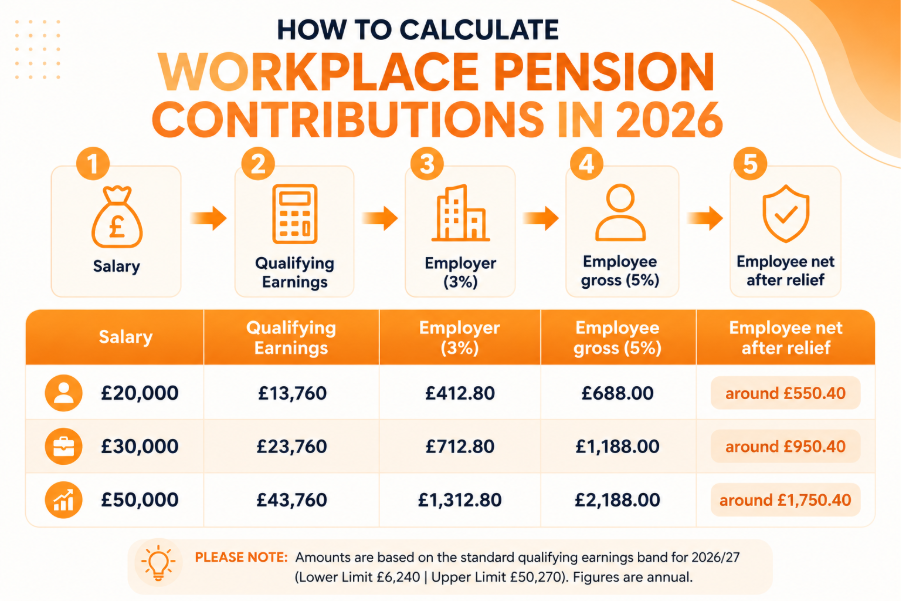
Here’s an example. Say someone earns £30,000. Their qualifying pay is £30,000 minus £6,240, which is £23,760. The firm’s 3% share is £712.80 a year. That works out to about 2.4% of the full wage.
So, if a firm’s share is below 3% of gross pay, that’s not a mistake. It just reflects the £6,240 cut-off.
How Much Do Employees Contribute to a Workplace Pension?
Staff often hear they pay 5%. That’s simple maths: 8% minus the firm’s 3% leaves 5%.
But in real life, the deduction often looks different. Why? A few reasons. Some firms pay above the 3% floor. Tax relief cuts what’s taken from net pay. And staff can add more on their own, or gain from a match above the legal rate.
Why Does My Payslip Show a 4% Pension Deduction Instead of 5%?
This comes down to a system called relief at source. Here’s how it works. The pension firm claims tax back and adds it to the pot on its own. So, a 5% share often shows up as 4% taken from net pay.
The pot still gets the full 5%. Nothing is lost. The tax office sends the last 1% straight to the pension firm, not through the payslip.
What Are Qualifying Earnings for Workplace Pensions in 2026?
Qualifying earnings are the pay band used to calculate the floor rate. For 2026/27, this band runs from £6,240 to £50,270 a year.
Pay below £6,240 is left out. Pay above £50,270 is capped. This is why the actual payment usually ends up being smaller than a flat-rate on full pay would suggest.
What counts as qualifying pay? In short: basic pay, wages, bonuses, overtime, and some sick or maternity pay. This matters in real terms, since the amount can shift month to month when pay varies.
What Is the Difference Between £6,240 and £10,000?
These two figures do different jobs. Mixing them up is a common slip, so let’s set them apart.
£6,240 is the lower pay limit. It’s the point at which the floor rate starts to apply once someone is already in a scheme.
£10,000 is the auto-trigger join. It decides whether a worker must be signed up at all.
A worker can earn between the two and not be auto joined. But if they ask to join, payments still start from £6,240.
What Happens If an Employee Earns Less Than £10,000?
They will not be auto joined. But they are not shut out of a pension either.
Anyone above £6,240 can ask to join and get the firm’s share too. Even below £6,240, staff can still ask to join. The only change is the firm does not have to pay in.
Who Must Be Automatically Enrolled into a Workplace Pension in 2026?
Auto-join applies to workers who meet four checks at once. They must be aged 22 or over and under State Pension age. They must earn more than £10,000. And they must work in the UK as a rule. Getting these checks right from day one starts with clear terms set out in the employment contract itself.
Do Employees Under 22 Need to Be Auto Enrolled?
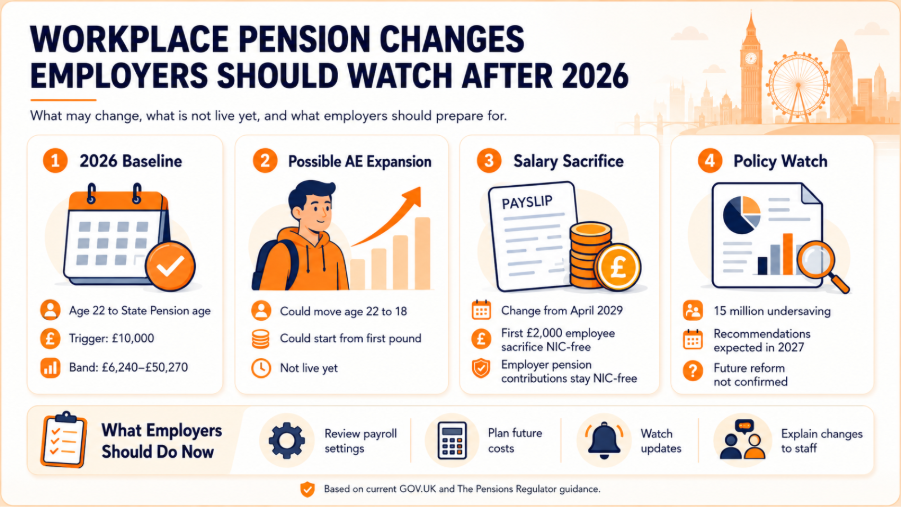
Not under the rules right now. A 2023 law gave the government the power to drop the age from 22 to 18. But here’s the key point: that power has not been used yet.
The 2026/27 age stays at 22. Firms should treat a lower age as a future step, not a rule that applies now.
Do Part-Time and Zero-Hours Workers Qualify?
Hours alone do not decide this. What counts is pay, work status, and how pay is checked each period.
Take a zero-hours worker whose pay exceeds £10,000 in a single period. That alone can trigger a join for that period, even if the hours vary widely.
What Happens When Employee Earnings Move Above or Below the Threshold?
Payroll must check this every single period, not just once a year. Overtime and bonuses can push a worker above £10,000 one month, then below it the next. This shift can bring them into scope, even if their normal pay sits below the mark.
What Happens When Salary Exceeds £50,270?
Pay is capped at £50,270 under the standard rule. So, a worker on £70,000 still has £44,030 of pay used for the sums. That’s the same figure as a worker on exactly £50,270. Extra pay past that point does not add to the floor rate, unless the scheme says so.
How Are Bonuses, Commission and Overtime Treated?
These count as qualifying pay in most cases. So, a bonus month can push the amount up for that one period.
Here’s an example. A worker on £2,500 a month gets a £1,000 bonus. Their pay figure jumps up for that month only, then drops back the next month. Payroll should expect this shift. It’s normal, not a fault.
Qualifying Earnings vs Pensionable Earnings
| Feature | Qualifying Earnings | Pensionable Earnings |
| Definition | Set band fixed by law | Set by the firm’s own scheme |
| Thresholds | £6,240 to £50,270 | Set by scheme, sometimes no cap |
| Full salary included | No | Often yes, depending on scheme |
| Effect on contributions | Often lower sums | Can be higher |
Two schemes can give different sums for the same wage. Why? Firms can pick their own pay rule, if it meets or beats the legal floor. One firm might use qualifying pay. Another might use full basic pay. Both can be fully within the rules, even though the sums come out different.
The Pensions Regulator also allows a few set alternatives. Set 1 needs at least 9% in total, with 4% from the firm, on basic pay only. Set 2 needs at least 8% in total, with 3% from the firm, provided that pay that counts are at least 85% of total pay. Set 3 needs at least 7% in total, with 3% from the firm, where all pay counts. It’s worth checking the exact rule your firm uses against current guidance, since paperwork can differ from payroll’s assumptions.
How Pension Tax Relief Affects Employee Contributions
Pension contribution tax relief under UK rules means that staff rarely pay the full quoted rate from their take-home pay. Here’s why.
Under relief at source, the pension firm claims basic tax relief and adds it to the pot. So, the payslip cut looks smaller than the full sum paid in.
Under a net pay deal, the sum is deducted from gross pay before tax is deducted. Relief then occurs automatically through payroll, and the payslip cut matches the full sum.
Higher-rate payers may claim more relief through their tax return under relief at source, a point worth checking alongside your own self-employed tax deductions if you also draw self-employed income. This depends on each person’s case, so treat it as background, not personal advice.
Salary Sacrifice and Workplace Pension Contributions in 2026
Salary sacrifice means a worker gives up part of their gross pay. In turn, the firm puts that sum into the pension as its own share instead.
Since the given-up sum no longer counts as pay, both sides save on National Insurance for it. On a payslip, this often shows up as a larger firm share alongside a lower gross wage.
For 2026/27, salary sacrifice amounts remain fully exempt from National Insurance, with no cap. That changes later. From 6 April 2029, only the first £2,000 given up each year stays free. Any sum above that will be subject to National Insurance as usual. This was set out at the Autumn Budget 2025, but it does not apply during 2026/27.
Workplace Pension Costs for Employers
Workplace pension employer costs go well past the 3% headline rate. Workplace pension costs for employers often cover the share itself, payroll admin, sending data to the provider, software, checks on who joins, fixing slip-ups, and re-joining runs, costs that are often easier to track once outsourced accounting support is managing the wider books.
Here’s a real figure to anchor this. On a £40,000 wage, qualifying pay comes to £33,760. That means a firm floor of £1,012.80 a year, on top of all that admin. Firms that pay more or match staff sums will still spend more.
Workplace Pension Rules for Small Businesses
Pension contributions: small business UK duties start from the first hire. There’s no size pass once a firm takes on staff who meet the rules, a reality covered in more depth in our guide on managing payroll for small businesses.
Even one worker who qualifies can trigger full firm duties. That means picking a scheme and paying the floor rate. Firms with only directors and no other staff may be exempt in some cases, depending on their work status. So, check your exact case rather than assume a pass applies.
Pension Auto-Enrolment Duties for Employers
The day-to-day work covers a lot of ground. It means checking staff each pay run, spotting who qualifies, and picking a scheme that meets the rules. It also means joining staff on time, working out sums right, and taking the cut from pay. Firms handling several such workflows at once often bring in business process outsourcing to keep everything moving on schedule.
Past that, firms must send data to the provider, pay the sums by the deadline, and keep records for six years. They must also handle join and leave requests, run re-joining every 3 years, and complete their sign-off with The Pensions Regulator within 5 months of their start date.
Miss any one step, and it can pose a risk, even if the sums paid in are right.
Workplace Pension Contribution Deadlines for Employers
Pension contribution deadlines that employers must meet are not just a single date. A few dates matter here.
Payday follows the firm’s own run. Data usually goes to the provider soon after payday, according to the schedule set with them. The legal deadline to pay staff cuts to the provider is the 22nd of the next month, or the 19th by cheque. The firm’s own share is usually due on the same run, though the exact date should be set with the provider or trustees.
Special rules apply to the very first cut under auto-join. Treating every payment type as one fixed date is a common slip, and one you can dodge.
What Happens If Workplace Pension Contributions Are Late or Missing?
After a missed payment, work through this step by step. Find the staff hit. Check payroll and the data sent. Call the provider. Work out the shortfall. Pay the missing sum fast.
If a cut was taken from pay but never reached the pot, look into it right away. This can point to a payroll or bank slip.
Missed sums can usually be paid late. But paying the sum alone does not always close the case. The Pensions Regulator can still want a full account, especially where the delay was long.
What Happens If Pension Contributions Were Calculated Incorrectly?
If too little was paid, work out the gap and top it up. Fix the records too, so it does not happen again. If too much was paid, this usually needs to be sorted out with the provider, not a straight refund through payroll.
One common slip is using full pay instead of qualifying pay. Another is using qualifying pay when the scheme runs on a different set of rules. If a worker joined too late, that could bring both a rule issue and a back sum owed, since they should have had payments from their real join date.
Employer Pension Penalties and Non-Compliance
Employer pension penalties in the UK follow a set process set by The Pensions Regulator. It starts with a notice to act. If money owed has not been paid, a notice on the unpaid sum follows.
Ignore a notice to act, and a flat £400 fine can apply. From there, daily fines kick in, from £50 a day for the smallest firms up to £10,000 a day for the largest, until the case is fixed. A firm that acts on purpose or ignores the rules can face further legal action, up to and including court action in serious cases, a compliance risk similar in scale to the exposure firms face under IR35 payroll rules.
Always check the live figures on The Pensions Regulator’s own site before you rely on them for your own case.
Common Workplace Pension Contribution Mistakes
- Thinking the firm’s 3% means 3% of full gross pay
- Mixing up the £6,240 limit with the £10,000 trigger
- Thinking staff always lose a full 5% from take-home pay
- Not checking which tax relief method, the scheme uses
- Missing how bonuses and overtime move qualifying pay
- Missing staff who cross £10,000 mid-year
- Using the wrong pay rule for the scheme
- Missing data sends or payment deadlines.
- Getting join or leave requests wrong, or skipping re-joining
- Thinking small firms are exempt
- Treating the 2029 salary sacrifice change as live now
Why Doesn’t My Workplace Pension Contribution Match What I Expected?
| What You See | Likely Explanation | What to Check |
| Firm’s share below 3% of pay | Based on qualifying pay, not full pay | Confirm the scheme’s rule |
| Your cut is around 4% not 5% | Relief at source applied | Ask which tax relief method the scheme uses |
| Sums stop rising at higher pay | £50,270 cap reached | Confirm whether the scheme caps at £50,270 |
| Sum rises after overtime | Overtime counts as qualifying pay | Check if variable pay is included |
| Sum changes each month | Variable pay moves qualifying pay | Compare qualifying pay across months |
| You pay less than expected | Firm pays above the 3% floor | Check the firm’s own rate |
| Provider shows sum as firm funded | Salary sacrifice deal is in place | Confirm whether salary sacrifice applies |
| Payslip shows a cut but the pot does not | Data or payment delay | Contact payroll and the provider right away |
| Two staff have different rates | Different set rules or terms | Compare each person’s scheme paperwork |
Workplace Pension Compliance Checklist for Employers
This workplace pension compliance checklist covers the main spots worth a regular look:
- Who qualifies, checked each pay run.
- Current limits
- The right pay rule
- Firm and staff rates match the scheme’s paperwork.
- The right tax relief method
- Pay that moves month to month
- Join and leave requests.
- Data sent on time
- Checks against the provider’s records
- Payments made by the legal deadline
- Files the provider rejects
- Shortfalls
- Six-year record keeping
- Re-joining timing
- Payroll software set up right.
- Law changes, including ones still to come
How Eco Outsourcing Can Help Employers Manage Workplace Pension Contributions
A lot of what we’ve covered comes down to small slips. Mixed up pay limits. Missed deadlines. The wrong pay rule. These are the exact kind of things that slips through when payroll runs without real pension know-how, and it’s often the deciding factor when firms weigh in-house payroll against outsourcing.
Eco Outsourcing supports UK firms with checks on who joins, auto-join runs, working out sums, taking the right cut from pay, and sending data to the provider. This runs on to checking that records match, handling join and leave requests, re-joining runs, keeping records clean, and fixing gaps before they turn into rule trouble.
For small and growing UK firms, most of all, expert payroll help can reduce the risk of the slips listed in this guide.
Frequently Asked Questions
Not always. The firm’s floor is 3% of qualifying pay. Some schemes match what you add, but that hangs on the scheme’s own rules, not the law.
In most cases, yes. These usually count as qualifying pay. So a bonus month can lift sums for a while, then drop back the next period.
The firm’s share usually keeps going during paid maternity leave. It’s based on your normal pay before leave began, even where your actual pay drops under statutory maternity pay. Your own share is usually based on the pay you get. It’s worth checking the exact rule with your pension provider, since scheme rules can differ.
Yes. Missed sums can usually be paid late to fix the gap. That said, firms should still expect to explain the cause to The Pensions Regulator when the case is significant.
Conclusion
The gap between a plain 3% plus 5% sum and what lands on a real payslip comes down to three things: qualifying pay, the tax relief method, and the scheme’s own rules. It’s rarely a payroll fault.
So where should you start? If the firm’s share looks too low, check the pay rule first. If your own cut looks like 4% not 5%, check if relief at source is in play. If pay that moved changed the sum, check the qualifying pay for that one period rather than assume fault. If a cut appears on your payslip but not in the pot, match payroll records against what the provider received right away. And if you’re not sure about your join duties, check your scheme paperwork and payroll setup before your next pay run.
Getting workplace pension sums right protects staff savings for retirement. It also shields firms from rule trouble that’s easy to avoid. If your payroll needs a fresh look, Eco Outsourcing can help you check your workplace pension setup and keep sums right, on time, and fully within the rules.
Need help managing workplace pension contributions, auto-enrolment, or payroll compliance? Contact Eco Outsourcing for practical payroll support tailored to your business.