Introduction
The vast majority of those who work for themselves in the UK end up paying too much tax for their needs. It’s not because of earning too much money; rather, it’s because of overlooking claims they are entitled to.
The HMRC makes it possible to access the tax codes online. But the information contained in it is very hard to comprehend. A lot of information that can be found there is wrong and out of date.
This blog will definitely help you because it contains all the information you need about what you can deduct from your taxes and what you cannot.
The Key Rule
Every deduction comes back to one test. HMRC only allows costs that are wholly for business. If a cost also has personal use, you claim the business part only. If you can’t split them clearly, HMRC may block the whole thing.
Keep receipts. Keep records. HMRC can check your return for up to four years. From April 2026, if your income is over £50,000, you must keep records in digital form under Making Tax Digital.
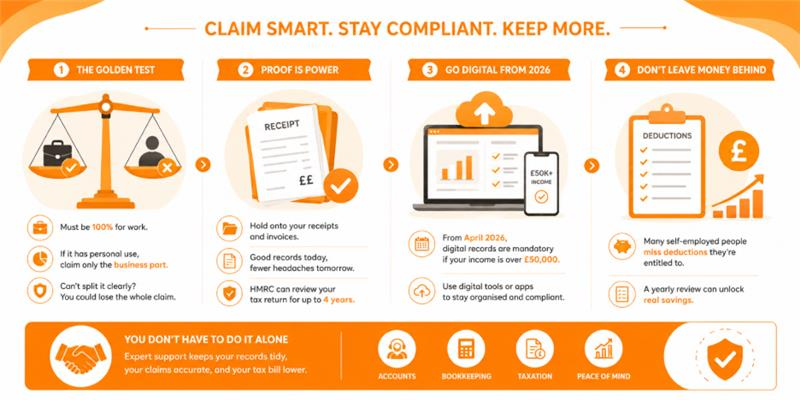
The good news is that the list of things you can claim is long. Most sole traders and freelancers don’t claim everything they’re entitled to. Going through a proper checklist once a year can make a real difference to your tax bill.
If staying on top of your records feels like too much to manage alone, professional accounts, bookkeeping and taxation support can help you keep everything organised year-round.
Office and Premises
If you rent business space, the full cost is deductible. That covers rent, rates, power, insurance, and repairs.
If you work from home, you have two choices.
The first is HMRC’s flat rate. It is based on hours worked at home each month. Work 25 to 50 hours and you claim £10. Work 51 to 100 hours and you claim £18. Over 101 hours earns you £26 per month. This covers heat and power for those hours. Phone and broadband are claimed separately on top.
The second is actual costs. You take your rent or mortgage interest, bills, council tax, and broadband. Then you split by rooms and hours used for work. For people with big bills and a dedicated workspace, this often gives a larger claim.
One risk: if you claim a room is used only for work, you may lose part of your home sale tax relief when you sell. Most sole traders keep rooms as mixed-use to avoid this.
Home Office Tax Deduction for Self-Employed UK
Use the flat rate if your hours are low or your bills are small. Use actual costs if your bills are high, and you can show the split clearly. Both methods are accepted by the HMRC. You can switch between methods from year to year, as long as you don’t mix them within the same year.
Travel and Vehicles
Business travel is deductible. A daily trip to a fixed place of work is not.
If you use your own car, the mileage rate is the simplest method. From 6 April 2026, this rose to 55p per mile for the first 10,000 business miles. It is 25p per mile above that. This was the first rise in over a decade. Keep a log with the date, place, and reason for each trip.
The other method is actual costs. Claim fuel, insurance, MOT, and repairs, cut back to business use only. Once you pick a method for a car, you stick with it as long as you own it. Try both in year one and take the one that gives more.
You can also claim parking costs, toll charges, and train or bus fares for business trips. Keep the receipts. Public transport costs are simply added to your travel expenses on your return.
Self-Employed Car Lease Tax Deduction UK
Leasing a car for work is often misunderstood. Here is how it works for sole traders.
If you lease a car with CO2 of 50g/km or less, you deduct the full lease cost, minus personal use. If it emits more than 50g/km, you must cut 15% from the lease cost first. Then you take off private use on top.
Take a £6,000 annual lease. You use the car 80% for work. First cut 15%, leaving £5,100. Then take 80% of that. Your deduction is £4,080.
Electric cars have no CO2 cut. They are the most tax-efficient choice right now.
Are Electric Bikes Tax Deductible for Self-Employed UK?
There is no mileage rate for self-employed cyclists. The 20p per mile rate applies to employees only. If you use a bike or e-bike for work, treat it as a business asset. Claim capital allowances on the cost, split by business use. Keep a log of work trips. If you only use the bike for personal trips, you can’t claim anything.
Equipment and Tech
Tools, computers, and kit are deductible. Large items go through capital allowances. The Annual Investment Allowance lets you write off up to £1 million in the year you buy. Most sole traders won’t come close to that limit.
Software, cloud storage, domain names, and web hosting are fully deductible in the year you pay. They are running costs, not capital items. Subscriptions to tools you use in your work, like design software or accounting apps, go here too.
Stock and Materials
If you buy goods to sell, or raw materials to make products, those costs are deductible. Under traditional accounting, adjust for stock at the start and end of each year. Under cash basis, you claim the cost when you pay it.
Marketing and Ads
Paid ads, SEO, website costs, business cards, and directory listings all qualify. Client meals do not. HMRC blocks all entertainment costs. There is no way around this rule. Even a working lunch with a client is not deductible. That catches a lot of people out.
Professional Fees
Accountant fees, legal costs, and other business services are deductible. Trade body and professional memberships also qualify if they are for your work. The fee for preparing your Self Assessment tax return is also deductible. Many people miss that one. If you use an outsourced accounting service to handle your bookkeeping and returns, those fees are an allowable business expense too.
Insurance
Business insurance is deductible. Public liability, indemnity, and equipment cover all qualifying. Business bank charges and loan interest are allowed too. Cash basis users have a £500 cap on loan interest. If you pay interest on a business credit card, that is also deductible for the business portion of spending.
Health Insurance for Self-Employed
This comes up a lot. The answer depends on how you trade.
If you are a sole trader, private health insurance is not deductible. HMRC sees you and your business as one. The cover benefits you as a person. So, it is a personal cost.
Is Private Health Insurance Tax Deductible for Self-Employed in the UK?
For sole traders, the answer is no. For those who run a limited company, the company can pay and deduct it. But the premium becomes a Benefit in Kind for you personally. You will owe income tax on the value.
The company also pays Class 1A National Insurance on it. So, it is not a free deduction. It cuts the company tax bill but creates a personal charge for you. Whether it still saves money depends on your tax rate and the size of the premium. Worth running the numbers with an accountant before deciding.
Life Insurance and Tax
Standard personal life insurance is not deductible. HMRC treats it as a personal product.
Is Life Insurance Tax Deductible for Self-Employed?
Not through a personal policy. But a relevant life policy through a limited company is different. The company pays. The premium is a business expense. It is usually not treated as a Benefit in Kind for you.
So, you get tax relief on the premium without a personal charge. For limited company directors who want life to cover, this is far better than a personal policy. Sole traders do not have access to this. It is a limited company perk.
Pension Contributions
Pension contributions are one of the best and most underused deductions for self-employed people. The relief is real and it adds up fast.
With a personal pension or SIPP, your provider claims 20% tax relief from HMRC and adds it to your pot. Pay in £80 and your pension gets £100. If you pay 40% or 45% tax, you claim extra relief through Self Assessment. Your real cost can fall to £60 or even £55 per £100 that ends up in your pension.
Are Pension Contributions Tax Deductible for Self-Employed?
Yes. Your provider handles basic rate relief for you. You claim extra if you pay higher or additional rate tax. The annual limit for 2026/27 is £60,000. But you can’t exceed 100% of your taxable income. You can also carry forward unused limits from the past three tax years. This is helpful if your income varies from year to year.
If you run a limited company, the company can pay your pension directly. That cuts the corporation tax bill. It also avoids income tax and National Insurance on that money. For many directors, this is the most efficient way to move profit out of the business. A financial planning and analysis service can help you model the most tax-efficient approach for your income level.
Eye Tests
Is Eye Test Tax Deductible for Self-Employed?
Only if the test is because of screen use for work. Glasses prescribed only for screen work may also qualify, but only if you use them solely for that purpose. General glasses are not deductible. They have personal use. A pair used only at your screen would pass the test. Most people skip this claim as the saving is small.
Therapy
Is Therapy Tax Deductible for Self-Employed in UK?
Usually no. HMRC treats therapy as personal health. The exception is if your role requires clinical supervision as part of a licensed job. Some counsellors and therapists must attend supervision to keep their licence. That counts as a work cost. For most sole traders, therapy stays personal. Stress affecting your output is not enough for HMRC to allow the claim.
Clothing
Are Clothes Tax Deductible for Self-Employed?
No, unless they are uniforms with a logo or protective gear your trade needs. Safety boots, hi-vis jackets, and trade wear qualify. A suit does not. Stage costumes for performers are a grey area. A musician buying stage gear not worn in daily life has a stronger case. HMRC looks at each case on its own.
Food and Drink
Is Food Tax Deductible for Self-Employed?
Daily meals are not deductible. Food is personal. The exception is meals bought during real business travel away from your normal base. A client visit in another city, with a meal bought on the way, may qualify. A trip to your usual workplace does not.
Self-Employed Musician Tax Deductions
Musicians and performers have some unique allowances. Travel to gigs is deductible, including train fares and fuel. Instrument costs and repair bills are deductible. Stage gear that would not be worn in daily life can qualify. Professional subscriptions to music bodies count. Recordings made for show reels may also qualify. Keep records of what each cost was for.
If You Have Employees or Subcontractors
If you pay staff or subcontractors, those costs are deductible. That includes salaries, employer National Insurance, and pension contributions you make on their behalf. Keeping payroll records clean is also important for compliance. Outsourced payroll services can handle pay runs, HMRC submissions, and employee queries so your records stay accurate and on time.
What You Cannot Claim
Fines are blocked. Parking tickets, speeding fines, and HMRC late charges are all out. Client meals are not allowed. Normal clothes are not allowed. Private health cover for sole traders, personal life cover, gym fees, and daily food are all blocked.
The test never changes. Did this cost arise for the business? Or for you as a person?
Making Tax Digital from April 2026
If your income exceeds £50,000, MTD for Income Tax is now live. You need digital records and four quarterly updates to HMRC per year. The £30,000 income threshold follows in April 2027. The £20,000 threshold comes in April 2028.
This changes how you report. It does not change what you can claim. Scan receipts as you get them. Do not leave it to January. If you’re already below £50,000 but heading towards it, now is a good time to start getting your records in order. Outsourced bookkeeping services that work with your existing tools like Xero or QuickBooks can help you stay MTD-ready without adding to your workload.
What Goes Wrong
Claiming personal costs as business expenses is the most common error. HMRC will flag mixed-use items without a proper split.
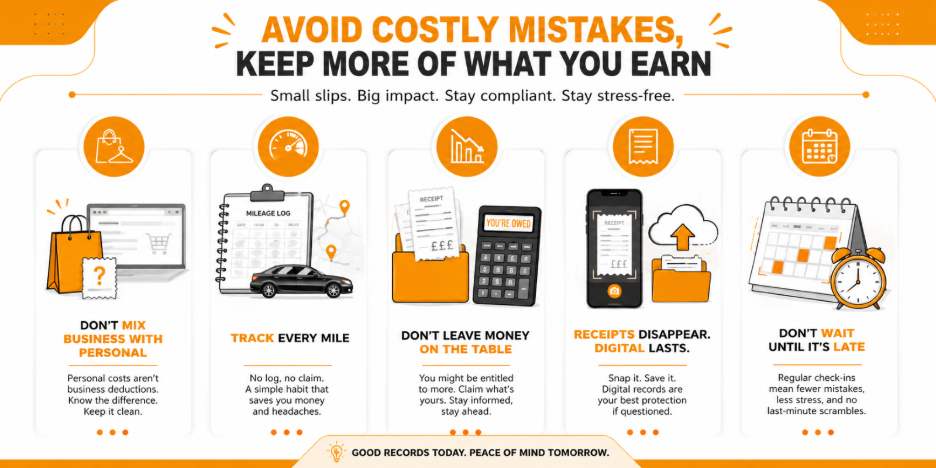
Not logging mileage is a costly habit. Without a log, your vehicle claim fails if HMRC asks.
Underclaiming is just as bad as overclaiming. Many people skip things they are entitled to because they are not sure. Keep the receipt. Put it in. If HMRC asks, you explain.
Losing receipts used to be common. It is less excusable now. Take a photo the same day. Cloud apps store them for you.
Leaving everything to January means you will miss things. A monthly or quarterly check is far more reliable. Read more on why in our guide to the benefits of outsourcing accounting services in the UK.
Conclusion
Tracking all of this takes real time. Sorting costs, splitting mixed-use items, and keeping clean records is hard when you are also running a business. If your records are a mess by December, you will miss deductions and stress about the deadline.
Eco Outsourcing provides outsourced bookkeeping and accounting support for UK businesses. Their team handles ongoing records, keeps your figures clean, and makes sure nothing gets missed by the deadline. If you want less time on admin and more on your actual work, get in touch with Eco Outsourcing to find out more.
Frequently Asked Questions
Only during real business travel away from your normal base. Daily meals are not allowed.
For sole traders, no. For limited company directors, the company can deduct it. But you will owe income tax on it as a Benefit in Kind.
Yes. Your pension provider adds 20% basic rate relief. Higher-rate taxpayers claim more through Self-Assessment.
Personal life insurance is not. A relevant life policy through a limited company is a deductible business expense.
Generally, no. Required supervision for a regulated job is the exception.
You can claim actual costs tied to business use. There is no mileage rate for self-employed cyclists.
Normal clothes are not. Branded uniforms and protective gear are.
Lease costs are deductible, reduced for personal use. Cars over 50g/km CO2 face an extra 15% block before personal use is removed.