
Payroll Outsourcing in the United Kingdom: Costs, Compliance & Provider Checklist
- Home
- Business Process Outsourcing
- Payroll Outsourcing in the United Kingdom: Costs, Compliance & Provider Checklist

The Changing Face of UK Payroll
The UK fiscal landscape is the fulcrum of corporate governance in 2025, where payroll has evolved from an administrative drumbeat to a focal point for strategic risk management and EVP (Employee Value Proposition) Payroll Outsourcing UK is no longer simply an exercise in saving money, but rather a smart move towards operational resilience through what has been labelled as the most disruptive period of regulatory change seen for years. With businesses handling the challenge of post-Brexit labour markets, increasing inflation, and a ‘digital-first’ requirement set by HMRC (His Majesty’s Revenue and Customs), dependence on expert third-party contractors is higher than ever.
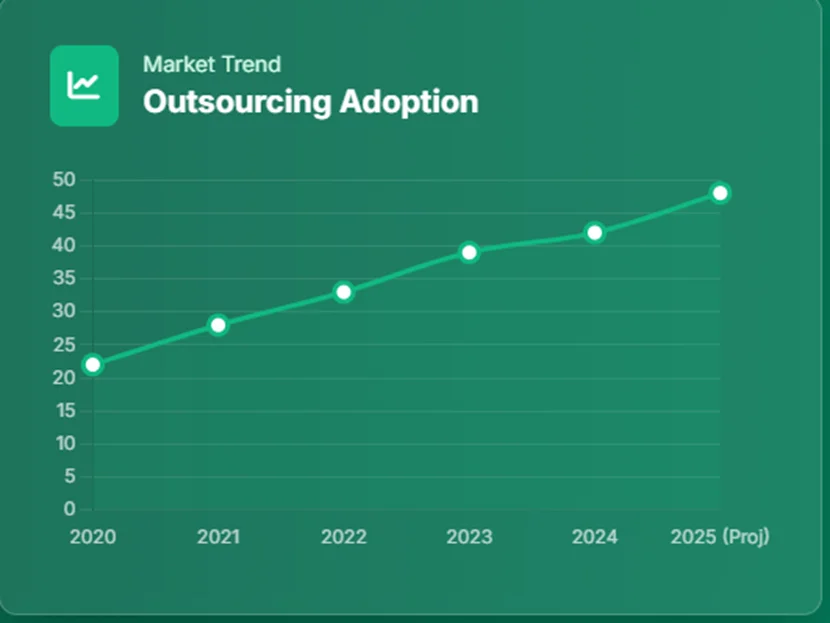
Today in the UK, the strategic importance of payroll outsourcing is the need for perfection. Research shows that 20% of employees are ready to quit their jobs after just one payroll mistake. The consequences for running an accurate and timely payroll cycle are no longer compliance-focused, but also touch on talent retention and company trust. Additionally, the UK payroll software and service market is predicted to grow to £1.58 billion by 2026, which represents more than a decade of consecutive growth as businesses ditch outdated, in-house solutions for fully integrated cloud-based suites. The trends in the near-term (2025 and 2026) are influenced by some of the key drivers.
Firstly, the use of Artificial Intelligence (AI) within daily payroll operations has moved from being a nice-to-have to a must-have. AI is even being used by some to spot anomalies, forecast cash flows required for National Insurance (NI) liabilities, and interpret new complicated tax rules. Second, the rise of real-time/on-demand pay, where employees can access their earned wages before the traditional payday, is also changing the relationship between payroll and financial well-being in industries with high levels of staff turnover, such as those in retail and social care. Last but not least, the increasing net of compliance or Employer National Insurance 15%, and the pulling down of the secondary threshold to £5,000, has meant that internal mistakes have become financially impossible for many small businesses.
What Is Payroll Outsourcing? Scope and Operational Mechanics
- Payroll Outsourcing means arranging for the full computation of gross pay, statutory deductions including tax (PAYE) & National Insurance Contributions (NIC), providing the same to people/company affected in accordance with law and regulations and the payment of net salaries after obtaining necessary approvals from a customer using an external service provider. Within the UK, these services tend to be classified with reference to the degree of control retained by the client: full service, where the provider has complete control over every step in the cycle, versus partial service (or bureau), where some aspects are still managed or accepted through data entry and approval by clients. In the UK, modern outsourced payroll management services have become extensive and go beyond merely producing pay slips. It is an ongoing process of validating data and regulator engagement. Employers need to report all payments made in respect of a particular pay period through RTI “on or before” the day payment is made to an employee.
Typical Outsourced Tasks
In a professionally managed service, such workloads are just standard parts of the operational lifecycle:
| Feature | In-House Payroll | Outsourced Payroll (UK) |
|---|---|---|
| Cost Structure | High fixed costs (salary, software, training) plus high variable risk (HMRC fines) | Predictable, scalable per-employee fee |
| Expertise | Dependent on one or two non-specialist employees | Specialist payroll team with up-to-date UK legislation knowledge |
| Compliance Risk | High exposure to HMRC penalties for non-compliance | Significantly lower risk; compliance managed by provider |
| Security | Typically lower security standards (local files or basic servers) | Higher security standards, often ISO 27001 payroll certified |
| Data Management | Processing starters and leavers, updating tax codes from HMRC notices, and managing P45/P60 distribution manually. | Full management of starters/leavers, HMRC tax code updates, and compliant P45/P60 handling by payroll specialists. |
| Statutory Calculations | Computing PAYE income tax, Class 1 National Insurance, and student loan repayments internally with higher error risk. | Accurate PAYE, National Insurance, and student loan calculations using HMRC-approved payroll systems. |
| Benefit Administration | Managing SSP, Maternity/Paternity Pay, and Statutory Neonatal Care Pay with limited specialist expertise. | Complete administration of SSP, SMP/SPP, and Statutory Neonatal Care Pay in line with UK legislation. |
| Pension Governance | Assessing auto-enrolment eligibility, processing pension contributions, and liaising with providers manually. | Automated pension auto-enrolment, contribution processing, and provider liaison (e.g. NEST, People’s Pension). |
| Payment Fulfilment | Managing salary payments and HMRC liabilities using internal banking and payroll tools. | Using BACS-approved payroll software to distribute net pay and settle HMRC liabilities securely and on time. |
Case Study: Eco Outsourcing and Optimal Performance
With several diverse parts of the business in different areas of the UK, we were dealing with getting to grips with shift patterns and calculations for payment, holiday pay for casual employees, and high labour turnover. Before the outsource, their internal team was spending at least 40 hours per month reconciling timesheets to payroll. Eco Outsourcing deployed a workflow that connected the timekeeping systems of the client to a payroll engine in the cloud. “This automated the rekeying of data, a universally recognised key error generator and resulted in all 400 staff receiving their pay correctly and on time, even during busier times.”
Client Quote: ‘Eco Outsourcing changed the way our payroll is done. The accuracy went through the roof, we never again missed a deadline, and our own staff at home had time to work on operations instead of spreadsheets.” Operations Manager, Hospitality Group (UK)
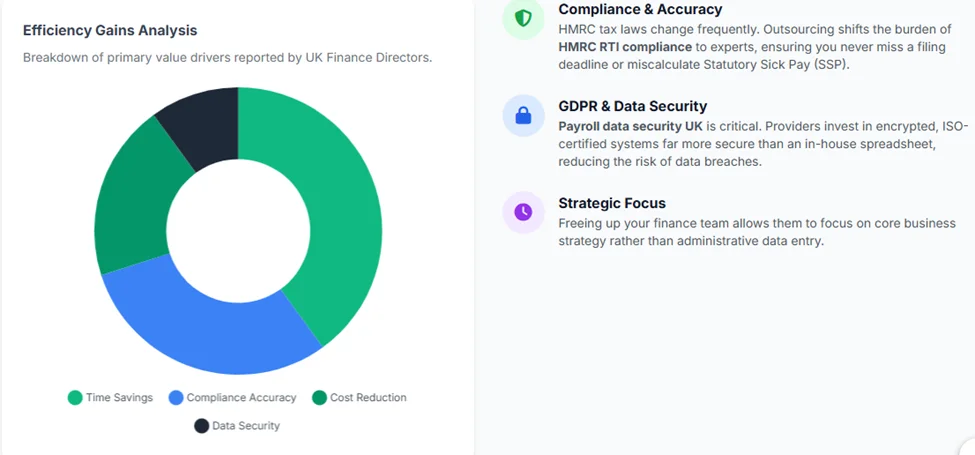
Overarching Benefits: Efficiency, Accuracy, and Change for the Good
The UK’s payroll landscape, as a result, is more and more about achieving an organisation’s ‘ peace of mind’. The intricate system of UK taxation alongside the face-melting penalties from HMRC can make life in-house in finance a pretty stressful affair.
Efficiency and Technological Leverage
“Outsourcing allows an enterprise to benefit from the service provider’s large technology investments. One company might not be able to afford high-end, AI-fueled payroll software, but these costs are shared across their clients by someone like Eco Outsourcing, and everyone gets access to the enterprise-grade stuff. This ‘on-demand tech’ model frees up the organisation’s internal resources from the task of dealing with software updates, security patching and hardware maintenance, which this company sees as extraneous to core-growth operations.
Accuracy and the Price of Being Wrong
The financial and reputational impact of payroll mistakes in 2025 is huge. Aside from the damage to employee relations, mistakes can invite HMRC scrutiny and fines. Payroll professionals are skilled at spotting anomalies that may not be picked up by an automated system, such as associates using the wrong tax code or salary sacrifice pension arrangements are being calculated incorrectly. In mid-sized organisations, the costs associated with correcting a single payroll mistake can be more than £200 in administrative time and potential penalties.
Compliance and Legislative Security
The UK is dancing around the moving target of compliance. As reported by the NCSC, the 2025-6 tax year also brings a series of changes, such as a 1.2 percentage point rise in employer NI rates and a new lower secondary threshold, which will hit low-wage areas the hardest. Outsourced suppliers provide a regulatory buffer to oversee the integrity of such modifications and their timely application. This proactive approach carries over to the UK’s GDPR (the General Data Protection Regulation), which enforces onerous responsibilities for how personal and sensitive employee data, including salaries, bank details and NI numbers, is retained and managed.
Case Study: Eco Outsourcing and Data Integrity/GDPR Read more >
An e-commerce company processing highly sensitive personal data for remote staff working across the UK and the US was worried about its internal payroll spreadsheets being secure. They feared hackers who could cause a data breach that would result in ICO investigations and huge fines. Eco Outsourcing transitioned its data to a private “personal data sanctuary” with encrypted cloud storage and multi-stage authentication. As a result, compliant pay slips are distributed to employees in the firm’s secure employee self-service portal rather than being emailed as an attachment, striking a balance between satisfying their GDPR responsibilities and offering high levels of convenience for staff.
UK Payroll Outsourcing Costs 2025: A Deeper Financial Examination
It is important to know the cost of payroll outsourcing in the UK for forecasting the ROI correctly. By 2025, the model will be largely built around volume and complexity and dominated by a few discrete models.
Dominant Pricing Structures
| Model Name | Description | Typical Rate (2025) |
|---|---|---|
| Per Employee Per Month (PEPM) | A monthly fee for every active employee on the payroll. This is the most common pricing model for businesses with stable headcounts. | £4 – £25 |
| Per Payslip Pricing | A fee charged for every individual payslip processed. Ideal for companies with fluctuating or seasonal staff. | £2 – £6 |
| Fixed Monthly Fee | A flat cost covering all payroll activities for a set period. Often used for micro-businesses. | £25 – £250 |
| Variable Salary Model | Designed for complex payrolls with high volumes of overtime, commissions, and varying pay frequencies. | Custom Quote |
Factors Influencing the Final Bill
There are a few factors that can push you from the low end of the pricing range (£4 PEPM) to the higher end (£25 PEPM):
- Completion: Four times the billing to process for weekly vs monthly payrolls (up to 15–30% higher in price).
- Pension Administration: Looking after auto-enrolment correspondence and uploading contributions usually costs around £1.50 – £2.50 per enrolled employee, per month.
- Deductions Complexity: The addition of attachment of earnings orders, student loans and complex salary sacrifice schemes leads to longer times highlighted in reconciliation.
The Sneaky Fees of Payroll Contracts
When comparing quotes, companies should not focus solely on the PEPM rate. There are usually “hidden” costs in the ancillary services:
- Setup/Onboarding: £50 for micro-firms and over £1,000 for large ones, including data migration and system configuration.
- End of Year Charges: P60, P11D and Final RTI submission charges.
- Ad-hoc Reports: custom reports that fall outside the realm of our standard monthly pack may be billed on an hourly basis or flat per-report charge
Case Study: Minimising cost using Eco Outsourcing
A local construction business was concerned about the price of hiring a team to handle their construction industry scheme (CIS) duties in-house. Their in-house accountant was drowning, having to check up on subcontractors and work out different rates for everyone. Eco Outsourcing offered an easy-to-understand line-by-line price list, layering both their regular employee payroll and their challenging CIS demands together in a single monthly cost. This allowed them to avoid an internal part-time hire, which, by their estimations, would have cost the company roughly £12k per year for the salary and software license.
Client Quote: CIS Outsourcing was one of the best decisions we made. Eco Outsourcing made a tricky process easier to understand and provided us with real, tangible savings for our business.” Director, Construction Company (UK)
On the trail of the Compliance Code in the UK!
Compliance: The single biggest challenge for UK payroll departments can be compliance. The demands of HMRC, employment law and data protection make the risk of getting things wrong a risky one for your corporate reputation and bottom line.
HMRC Real Time Information (RTI)
Under the RTI regime, employers must report pay and deductions to HMRC every time an employee is paid. This is achieved in two main submissions:
- Full Payment Submission (FPS): This shows the employee’s pay, tax and NIC details. It must arrive “on or before” payday.
- Employer Payment Summary (EPS): This is used to report values that could not possibly be included in the FPS, for example, statutory payment recoveries, or to tell HMRC that no employees had been paid in a particular period.
The automatic penalty system for late RTI returns is harsh. For the 2025-2026 tax year, these penalties are graduated as follows, depending on how many employees you have:
- 1–9 employees: £100
- 10–49 employees: £200
- 50–249 employees: £300
- 250+ employees: £400
IR35 and Off-Payroll Working
IR35 is still a controversial and confusing part of the UK’s tax legislation. Intermediaries, medium and large businesses in the private sector, are responsible for deciding the employment status of any contractors they engage through an intermediary. Mis-categorising the status of a worker as an independent contractor, when in fact they should be treated as an employee for tax purposes, can result in substantial amounts of back-tax and NICs becoming due. The key change for April 2026 is the introduction of Joint and Several Liability (JSL) into the umbrella company market, where tax debts are passed up the supply chain to end clients in cases where an umbrella company does not meet its obligations.
Auto-Enrolment and Pension Compliance
The Workplace Pensions Act 2008 made workplace pension schemes compulsory for all UK employers. And it is not simply a matter of putting the scheme in place; automatic checks on employee age and earnings must be made regularly so that “eligible jobholders” are automatically enrolled, while “non-eligible” employees are provided with an opportunity to opt in. The 2027 to 2028 tax year will retain the earnings trigger at £10,000, providing future policy stability while increasing the number of employees brought into the system as a result of wage inflation.
Get Real How-To: A ‘Speedy’ & Step-by-Step Guide to Payroll Outsourcing
Moving to an outsourced payroll is a significant project that will need careful preparation and stakeholder engagement in order not to disrupt the most sacred contract between employer and employee, getting paid on time.
The Due Diligence Checklist
Ahead of inking a deal, procurement and finance officers should consider providers based on the following criteria:
- HMRC Recognition: Is the supplier using HMRC-recognised software that can interact with the RTI portal?
- BACS Status: Is the provider an approved BACS bureau? This means they can take payments straight from your bank account with minimal human involvement.
- Data Sovereignty: Whose country or gateway is the payroll data residing in? “UK businesses, in a post-Brexit landscape, want their data hosted in the UK (or EEA), as it can facilitate GDPR compliance.”
- Service Capabilities: Is the provider capable of supporting your anticipated needs as you grow? Find indications, if any, of experience with handling like-sized clients or with multi-entity structures.
The Contract Template: Essential Clauses
When hiring a payroll provider, the best Payroll SLA (Service Level Agreement) should contain some important legalese and operational protection:
- Scope of Service: Be clear with what is in-scope (P11Ds, Pension uploads, etc.) and what is ad-hoc.
- DPA: Data Processing Agreement is a GDPR necessity that defines how the processed personal data will be dealt with by the processor on the controller’s instructions.
- Confidentiality: An undertaking that all payroll personnel are held to a duty of strict confidentiality.
- (b) Error Correction: Timeliness and responsibility for correcting processing errors.
- Rights of Audit: The right of the client to audit the processes and security around their data.
Onboarding and the Migration Timeline
| Phase | Timeline | Key Activities |
|---|---|---|
| Discovery | Weeks 1–2 | Review current systems, data structures, and pension arrangements. |
| Data Collection | Weeks 3–4 | Extracting and cleansing employee data (NI numbers, tax codes, YTD balances). |
| Configuration | Weeks 5–6 | Mapping data to the new system and setting up specific pay elements and rules. |
| Parallel Runs | Weeks 7–10 | Running the old and new systems simultaneously for 2–3 cycles to ensure identical outputs. |
| Go-Live | Week 11+ | The first official payroll run entirely managed by the new provider. |
Case Study: Seamless Migration with Eco Outsourcing
A hundred and fifty-year-old manufacturing company, married to its legacy 20-year payroll system, was terrified of its need to migrate off. They were concerned that “data rot” could result in improper payments during the transition. Eco Outsourcing’s migration team maintained a three-month cutover process, including a rigorous “data cleansing” exercise where each NI number and tax code was validated against HMRC data. In pursuing two full parallel runs, they identified and adjusted three historic under-calculation of pension contributions in the lead up to go-live. The switchover was so seamless that the employees did not even know their payroll operations had been outsourced for three months after receiving new digital pay slips.
CSP service levels and performance management: An accountability checklist
After migration, the aim becomes to stay at service level targets as far as possible. Key Performance Indicators (KPIs) “Performance Measures” The performance metric used to measure provider efficiency and effectiveness.
Core Payroll KPIs
| Metric | Definition | Targeted Benchmark |
|---|---|---|
| Payroll Accuracy | (Number of error-free pay slips / Total pay slips) × 100. | > 99.7% |
| Timeliness | Percentage of RTI submissions and payments made by the agreed deadline. | 100% |
| First Contact Resolution | The percentage of employee payroll queries resolved during the first interaction. | > 65% |
| Compliance Audit Score | The results of annual internal audits of tax and pension calculations. | 100% |
Performance Management and Escalation
Good management is more than just a numbers game; it is also about establishing something that looks like a feedback loop. Service reviews should look at what went wrong monthly to avoid the same mistakes in the future. An escalation matrix is also necessary, detailing who from each organization should be contacted if a serious problem, such as non-submission of an FPS or hold up in BACS payments, arises. We would be remiss not to consider and acknowledge the risks involved.
Challenges and Risks: A Realistic Perspective
The risk of HBV transmission through PCT has been greatly reduced due to routine donor testing for this virus. However, as we all know, outsourcing is not a silver bullet. Outsourcing introduces its own set of risks, which require active governance to mitigate.
Security and Controller-Processor Relation to the Data
Under GDPR, it is the employer who is the “Data Controller” and is responsible for the care of employee data. As even such a document may not make it to the BBC, for example if there is a leak from their side when they receive it, and as definitely none of these papers will come to someone exposed by our Provider having documents breached (the “Processor”), ICO would go after any enterprise using such processors which cannot show they had been diligent enough. This risk can be managed by selecting suppliers with ISO 27001 accreditation and strong encryption standards.
Business Continuity and Provider Failure
A payroll provider going out of business or having a technical failure is unthinkable. The 2026 JSL rules for umbrella companies show an alarming risk of “disappearing” intermediaries. Parties should review the financial soundness of a provider, and its disaster recovery plans, as well as whether it is possible to obtain a “back-up” of the present payroll database in case its systems crash.
Comparison: In-House vs. Outsourced Payroll
For some, it comes down to dollars and cents, that is, Total Cost of Ownership (TCO) vs. Monthly Service Fee.
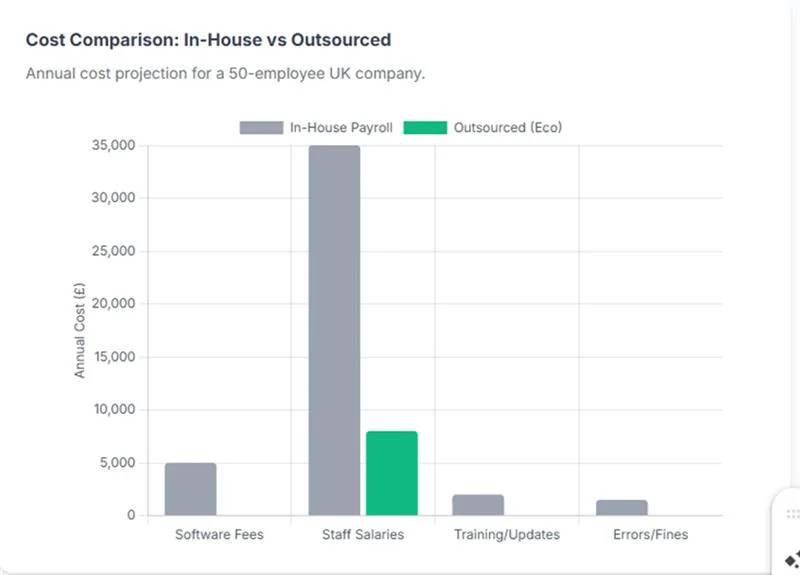
What In-House Payroll Really Costs
The cost to keep an in-house department has a lot of behind-the-scenes expenses:
- Staff: This does not include salaries; it also includes National Insurance, pension contributions and the cost of maintaining staff is continuing professional development (CPD) to keep them informed of legislative changes.
- Software: Annual licenses for cloud solutions such as Sage or Xero Payroll can be anything from £200 to over £1,200 (+ annual costs of any ‘add-on’ pension platforms).
- Risk: The “cost to get it wrong” includes HMRC penalties and the management time spent in correcting mistakes.
Sector & Company Size: Customising the Solution
Not all UK companies have the same payroll requirements. Each sector and size of business is under different pressures, which will determine its outsourcing strategy.
SMEs and Growing Startups
For companies with less than 50 employees in particular, outsourcing is usually about “leveraging expertise on demand.” These businesses are not in a place to employ a full-time payroll manager; however, they have the exact compliance requirements as a multinational. Startups in particular benefit from the PEPM pricing model, which enables their payroll costs to scale proportionally as headcount grows.
Large and Multi-Entity Corporations
For a company with hundreds or even thousands of employees, the task is to consolidate. Multi-entity support and advanced reporting. To be able to look after several subsidiaries with different PAYE schemes and possibly various pay frequencies, you will need a provider that has multi-entity support as well as good reporting.
Large Companies – Focus on System Integration
Many large companies focus mostly on “System Integration” options to connect payroll data with their current ERP or Global Talent Acquisition solutions.
Sector-Specific Nuances
- Retail and hospitality: High churn and irregular hours mean a provider needs to handle high volumes of starters and leavers, as well as manage “on-demand pay” expectations.
- Build: CIS requires expertise in how subcontractors are taxed and monthly CIS returns, which not all generalist payroll administrators offer.
- E-commerce: Digital brands frequently employ remote, cross-border teams who need ‘Global Payroll’ capabilities to navigate dual tax residency and social security obligations.
Case Study: Multi-Entity Consolidation with Eco-Outsourcing
Three separate healthcare entities with their own PAYE scheme and multiple pension providers had to contend with inconsistent reporting and fragmented information. Eco Outsourcing developed a single “Executive Dashboard” that captured information from all three businesses, whilst still having specific HMRC compliance for each company. The Group Finance Director was then given a ‘single source of the truth’ for total workforce spend, for more accurate budgeting and resource deployment across the subsidiaries.
Client Quote: “A unified view of payroll data for different entities was a game-changer. Eco Outsourcing has provided clarity, control and confidence, and the schemes remained 100 per cent compliant.” Group Finance Director, The Healthcare Group
How Eco Outsourcing Can Help: The Hexa-Service Solution
In the UK market, Eco Outsourcing stands out from the competition by its “6 service” concept, where the company aims to offer not just a transaction but a partnership relationship with its supplier/customer.
The “Managed Professional” Philosophy
The Eco Outsourcing model is based on the “ECO” acronym:
- Employee loyalty: Working in the best interest of an in-house employee.
- Strategist savvy: Offering strategic compliance and efficiency guidance.
- Efficacy of outsourcing: Achieving the operational efficiency and cost advantage you would anticipate from a leading provider.
Comprehensive Service Integration
Eco Outsourcing’s core payroll processing services go beyond basic payroll to replace outdated manual systems. Their accuracy and attention to detail are second to none.
- Tax & Accounting Solutions: Offering support from VAT and tax planning through to HMRC investigation support.
- Remote Employees Management: Professional supervision of any organisation with employees who specify their work location (work from home, telecommuters).
- Data Sanctuary: Military-grade secure cloud storage and MFA protection of all sensitive HR and financial records.
FAQs
A bureau is usually concerned with processing data that you supply. A full managed service, such as the one provided by Eco Outsourcing, manages the entire process from payment to pension liaison and proactive compliance advice.
For a business of 10–25 employees, you are likely to be looking at £75 -150 for an average answering service, with Fully Managed packages costing more if the amount of work and complexity is particularly high.
No That is right, under the law, it is still ultimately the company that is legally responsible for making accurate and timely payroll tax payments. But a good service will have professional indemnity insurance, as well as “accuracy guarantees” that pay you for the cost of penalties if they are responsible.
The increase to 15%, along with the lowering of the secondary threshold to £5,000, combined means employers will effectively shell out a great deal more in NI for every employee who earns over £5,000 a year. This could amount to an extra £865.80 per year for a worker earning £30,000.
It is frequently an “add-on” to or may be included with higher-priced “Standard” or “Fully Managed” packages. It usually adds about £1.50 – £2.50 per employee each month.
Yes, but many companies prefer to change at the beginning of the tax year (April 6th) to make YTD reporting more straightforward. A professional provider can handle mid-year migration with a strong “opening balance” check.
Real Time Information (RTI) is how employers tell HMRC about PAYE. It is crucial because the filing deadline is literally “on or before” each payday; a late filing will immediately trigger automatic fines.
Yes, recent policy papers outline prospective liabilities for recruitment agencies and end clients from April 2026 if an umbrella company in their supply chain becomes a defaulter of unpaid PAYE and NICs.
Eco Outsourcing employs a “Data Sanctuary” model that involves data stored on an encrypted cloud with access controlled by multi-factor authentication, firewalls compliant with global security standards, etc.
An outsourced provider normally would correct on a “retroactive” basis in the next pay cycle, or if it is significant, process an off-cycle run. Performance statistics, such as “Accuracy Rate,” in your SLA should dictate these instances.
Conclusion: The Future of Your Workforce in the UK.
The evolution of payroll outsourcing in the UK is evident; it has shifted from a tactical requirement to a strategic imperative. “Now, as we have stepped into 2025 and move through to 2026, the dual assault of higher taxation and a ratcheting up of regulatory pressure together make ‘good enough’ payroll service a sizeable commercial gamble to take. The penalties from HMRC, liability in the supply chain, and loss of employee trust now significantly outweigh an investment in a professionally managed service. Working with a company such as Eco Outsourcing, businesses can turn payroll into more of a weapon than just the cause for grey hairs. By combining cutting-edge technology, an unrivalled level of compliance and security expertise, and a relentless focus on keeping data safe, Eco Outsourcing helps entrepreneurial leaders in the UK channel their time towards what really matters, driving growth, innovation and looking after our people. And the future of work in the UK is one that is digital, compliant and focused wholly on employees; outsourcing is the artery that takes you there.


Recent News

Why Outsourcing Is the Key to
6th November 2025
Why Business Process Outsourcing is the
14th August 2025