

Introduction
Managing the UK financial calendar takes more than a glance at a wall planner. For anyone handling company finances, a Payroll Holiday is a real challenge. Processing windows shrink. Banking systems pause. The risk of errors goes up fast.
Whether you run a small business or lead a payroll team, getting this right matters. One mistake can mean HMRC fines, delayed wages, and angry staff. Many UK businesses now use a professional payroll outsourcing service to remove this risk from their plate entirely.
In the UK, a bank holiday shuts down BACS. BACS is the system that moves money between accounts. If your payday falls on a bank holiday Monday, the prep work must start days before. This guide tells you exactly what to do so your staff get paid on time and HMRC stays satisfied.
What Counts as a Payroll Holiday in the UK?
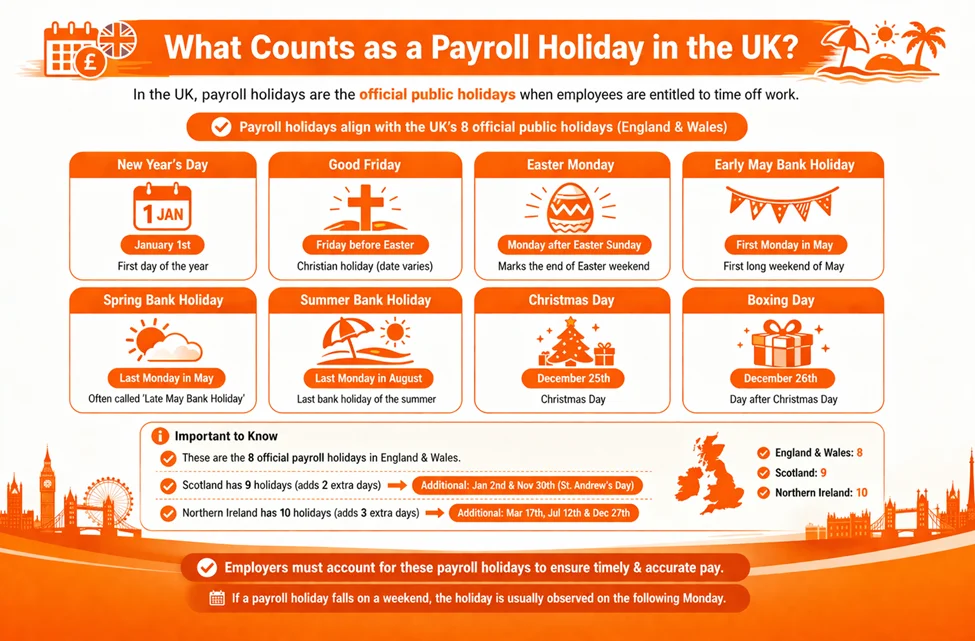
A Payroll Holiday UK is any day when clearing banks are closed. On these days, funds cannot move through standard automated channels. This mainly covers the statutory bank holidays across the four nations.
Regional Variations
Assuming one rule applies to all of the UK is a common mistake.
- England and Wales observe eight bank holidays.
- Scotland has nine, including January 2nd and a different August holiday.
- Northern Ireland has ten, including St Patrick’s Day and the Battle of the Boyne.
When your team is spread across the country, your payroll software needs to reflect each region. A colleague in Edinburgh may be off while your London office is working. This creates confusion around “substitute days.” These are extra weekdays given when a holiday falls on a weekend. If your system isn’t set up for each region, errors are easy to make.
Are Bank Holidays Automatically Paid?
There is no automatic legal right to paid bank holidays in the UK. The law gives workers 5.6 weeks of annual leave. But the contract decides if bank holidays count toward that total or come as an extra benefit. If the contract says nothing, you are not legally forced to pay. The employee would need to use their own leave instead.
What Are Your Employer Obligations on Bank Holidays?
Your duties as an employer on bank holidays come from two sources. The first is the Working Time Regulations. The second is the specific employment contracts you hold.
Statutory vs. Contractual Rights
By law, every worker must get their minimum leave. By contract, you may have agreed to pay extra on bank holidays. If a staff member works on a bank holiday, you do not have to pay a premium unless you promised it in writing. You should still track who worked, what rate they earned, and any time off in lieu (TOIL) they are owed. Good records prevent future disputes.
Compliance and NMW
The National Minimum Wage (NMW) is a key risk during bank holiday periods. Say an employee is on a flat salary and works extra hours over a holiday without extra pay. Their hourly rate for that period could drop below the legal minimum. HMRC now audits these “hidden” hours more often than before.
Holiday Entitlement and Carry-Over Rules
Leave management is a year-round task. Bank holidays often raise questions about rolling unused days over. Under statutory holiday pay rules, the basic principle is use it or lose it.
The 5.6-Week Rule
Most workers get 28 days (5.6 weeks) of leave per year. If you offer more than this, the extra days are contractual leave. Different carry-over rules apply to those days.
Sickness and Leave
Things get complex when an employee falls ill during a bank holiday or a booked vacation. If they are too unwell to work, they are not technically “on holiday.” So they can reclaim that day and use it later. This is one of the few cases where holiday pay accrual rules allow statutory leave to carry over into the next year. This only applies if the employee could not take the leave due to long-term illness or parental leave.
How Do You Calculate Holiday Pay?
Holiday pay should leave an employee in the same position as if they had worked. The Harpur Trust v Brazel ruling and 2024 law changes have shifted how this works for variable hours workers.
The 52-Week Reference Period
For workers with irregular hours, you must look back over the past 52 weeks they were paid. Skip any weeks with no work. Go further back, up to 104 weeks, to find 52 actual working weeks. This gives a fair average. It includes commission and regular overtime, not just base pay. This matters a lot when calculating holiday pay for part-time workers. If you are unsure about your approach, a specialist UK payroll management service can handle these calculations on your behalf.
The 12.07% Method (2024 Update)
From April 1, 2024, the 12.07% accrual method came back into use. It applies to irregular-hours and part-year workers only. It makes things much simpler for seasonal businesses. But you must apply it to the right type of worker. Getting this wrong creates a real risk of underpaying holiday pay.
Payroll Timelines and Bank Holidays
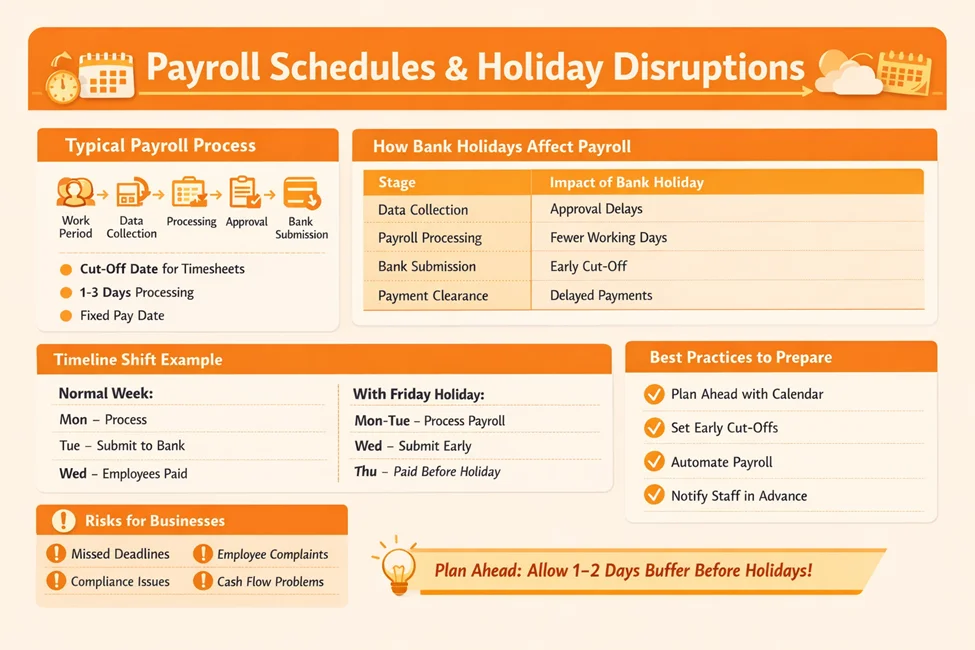
Your payroll timeline for bank holidays runs on the BACS cycle. BACS needs three working days to complete a payment.
- Input Day: You send the file.
- Processing Day: Banks communicate.
- Payment Day: Money clears.
If a bank holiday falls on any of these days, the whole cycle shifts. For a Monday bank holiday, the Input Day for a Friday payday must move to the Tuesday before. This means payroll processing on bank holidays requires tight internal deadlines. Timesheets and expenses must come in much earlier than usual.
Managing Adjustments
Moving deadlines often leads to payroll adjustments for holidays. Say your overtime cutoff is the 20th of the month. A bank holiday forces you to run payroll on the 18th instead. Two days of overtime then roll into next month’s pay. Clear communication here stops employees from getting confused.
Paying Employees Early Due to Bank Holidays
When a pay date falls on a weekend or bank holiday, the standard practice is to pay on the last working day before it.
The Operational Reality
Paying early for a bank holiday compresses your working month. If data is not in on time, this can trigger an emergency early payroll run. It is a good gesture for staff, but it takes extra admin time and produces early payslips ahead of schedule. You also need a clear early pay policy. Staff must know their early payment has to last until the next pay cycle.
Do You Need Consent?
Most UK contracts let the employer change the pay date with reasonable notice. You usually do not need written consent for a one-off early payment due to a holiday. Even so, it is good practice to announce the change at least one full pay cycle in advance.
RTI Rules During Payroll Holidays
HMRC’s Real Time Information (RTI) system is where most errors happen during a Payroll Holiday. The rule is clear: submit a Full Payment Submission (FPS) on or before the day you pay your employees. Businesses that use a managed payroll outsourcing service have this handled automatically, so RTI deadlines are never missed.
The “Contractual Date” Easement
HMRC offers a useful easement for bank holidays. If you pay early, you should still record the regular contractual pay date on your RTI submission. Here is an example:
- Contractual Pay Date: Friday, May 22nd
- Actual Bank Holiday: Monday, May 25th
- Early Pay Date: Thursday, May 21st
- RTI Report Date: May 22nd
This keeps the payment in the right tax month and protects Universal Credit. If you get this wrong, HMRC may read the payment as late. This can trigger an RTI late submission penalty or cause wrong tax codes for your staff.
Tax and Benefits Impact of Early Pay
Early pay usually has little impact on the employer. But it can cause real harm to the employee.
The Universal Credit “Double Pay” Issue
This is where many employers slip up. If you pay early and report it to HMRC, the DWP may see two payments in one Universal Credit assessment period. This can cut the employee’s benefits to zero for that month. Using the contractual date in your RTI filing removes this risk entirely.
PAYE and NI
Paying early near the end of the tax year, in March or April, can push earnings into the wrong tax year. This may move an employee into a higher tax bracket. Make sure your payroll software handles Month 12 to Month 1 transitions correctly when a holiday disrupts your usual schedule.
Holiday Pay Recordkeeping and Audit Readiness
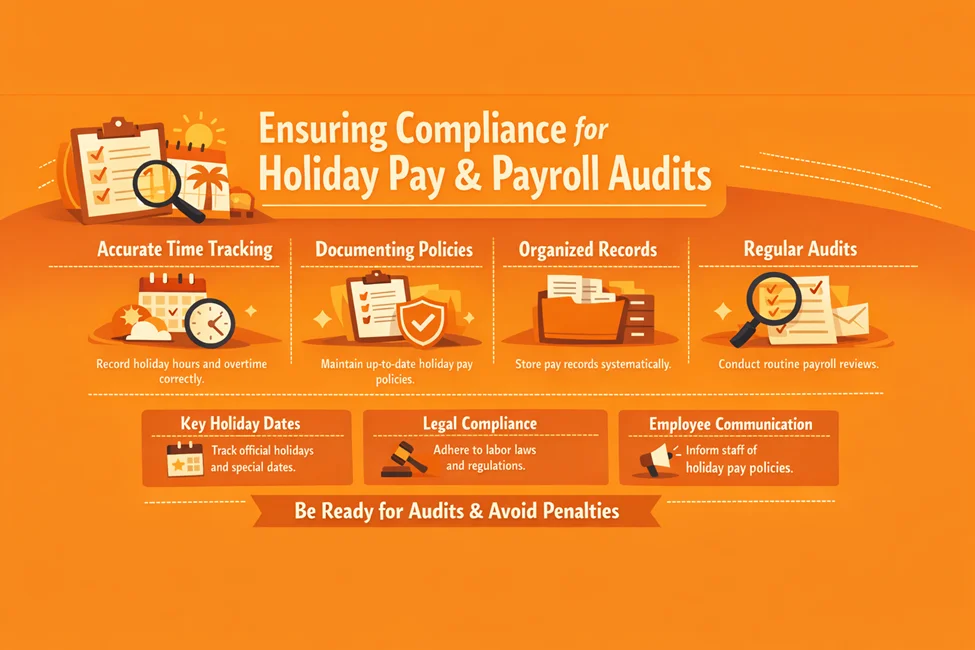
If HMRC runs a holiday-pay audit, they will not just check your final numbers. They will review your method and process. If your accounts, bookkeeping and taxation records are well-organised, audit preparation becomes much easier.
Required Documentation
Your holiday pay recordkeeping checklist should include:
- Records of “normal pay” calculations, including how you counted overtime and bonuses
- The 52-week average for every worker with irregular hours
- RTI confirmations showing the contractual pay date
- Proof that you told staff about any early payment
HMRC will look for signs of “rolled-up” holiday pay. This means paying an extra percentage each month instead of paying when leave is actually taken. It remains a high-risk area for non-compliance.
Common Payroll Holiday Errors and How to Avoid Them
Even good teams make mistakes. These are the most common payroll penalties and RTI errors to watch for:
- Wrong date on RTI: Using the early pay date instead of the contractual date disrupts Universal Credit.
- Missing the BACS window: A Monday bank holiday can make Tuesday a non-processing day. This delays pay by 24 hours.
- Leaving out commission: Excluding regular commission from holiday pay creates a real underpay risk.
- No correction filed: Fixing an error after the holiday without sending an Additional FPS or Earlier Year Update.
To avoid these, build a buffer day into your payroll timeline bank holiday planning. If Wednesday feels like your deadline, aim for Tuesday. If you want to understand what to look for in a reliable provider, this guide on how to choose a payroll outsourcing provider covers a practical 10-point checklist.
Real-World Payroll Holiday Scenarios
Scenario 1: The Friday/Monday Double Holiday (Easter)
Easter is the hardest test. Good Friday and Easter Monday are both bank holidays.
The Problem: Your normal three-day BACS window now spans nearly seven real days. The Solution: Finalise payroll for a Friday payday by Monday or Tuesday before. Late data will almost always force an emergency early payroll run.
Scenario 2: The Variable Hours Seasonal Worker
A student works 30 hours over the Christmas break. In November, they only work 5 hours. They take leave in January.
The Trap: Using just their November average means you are underpaying them. The Fix: Use the 52-week average. This captures the higher December earnings and gives them a fair rate.
How ECO Outsourcing Can Help
Payroll processing during bank holidays puts huge pressure on already busy teams. Our payroll outsourcing services remove that pressure entirely.
- Bank Holiday Execution: We manage the BACS calendar so every early pay run goes smoothly.
- RTI Excellence: Our team files every RTI submission with the right HMRC easements. Your staff’s benefits stay safe.
- Accuracy Guaranteed: We apply the correct holiday pay accrual rules. Every commission and overtime hour gets counted.
- Emergency Support: If your team hits a bottleneck, our emergency early payroll run service keeps you compliant.
Outsourcing removes the risk of underpaying holiday pay. It also builds your reputation as an employer that gets payroll right. If you are weighing up the cost of making the switch, this breakdown of how much it costs to outsource payroll in the UK gives you clear 2026 figures.
Final Takeaways
A Payroll Holiday does not have to cause a crisis. Shift your focus from the bank holiday date to the BACS window and the RTI report date. That simple change puts you in control.
The three golden rules are:
- Communicate: Tell staff when they will be paid and when data is due.
- Report correctly: Use the contractual pay date on your HMRC submission to protect Universal Credit.
- Calculate fairly: Always include normal pay in holiday calculations, not just basic salary.
Get this right and when the bank holiday Monday comes around, your whole team can enjoy the day off. If you want a team that handles all of this for you, get in touch with ECO Outsourcing for a free consultation.
Frequently Asked Questions
Yes. It is standard UK practice to pay early when the regular payday falls on a non-banking day. You do not normally need written consent. But do notify staff in advance so they can plan their budget.
Submit the FPS on or before the day you actually pay employees. Use the regular contractual payday as the “payment date” on the FPS. Do not use the early pay date. This keeps tax and benefit periods in line.
The RTI late submission penalty starts at £100 per month for small employers. It rises to £400 for employers with 250 or more staff. Inaccurate filings can lead to larger fines if HMRC finds them careless or deliberate.
No. There is no legal right to paid bank holidays. It depends on the employment contract. These days are often included in the 5.6-week statutory minimum, but this is not automatic for everyone.
Use the 52-week average. Add up earnings from the last 52 weeks worked and divide by 52 to find one week’s holiday pay. From April 2024, some workers may instead use the 12.07% method based on hours worked in each pay period.
Keep timesheets, 52-week average worksheets, BACS reports, and copies of your RTI FPS submissions. These records prove that the “on or before” rule was met and that all pay was calculated correctly.
Yes. If an employee could not take their statutory four-week core leave because they were on sick leave, they can carry it over. They must use it within 18 months of the end of the leave year it was earned in.
If a pay date shifts into a different tax month and no one is paid, you must still submit an Employer Payment Summary (EPS). Send it by the 19th of the next month. This tells HMRC that no payment is due for that period.
Underpaying can lead to back-pay claims for up to two years. It can also mean tribunal costs, reputational harm, and HMRC interest on unpaid tax and National Insurance.
Paying early for a bank holiday is widely accepted as a benefit to the employee. Most contracts or staff handbooks should include a clause that allows for this. With such a clause in place, you do not need formal consent each time.
Good payroll software lets you enter two dates. The first is the actual payment date for the bank transfer. The second is the HMRC payment date, which is the contractual payday. This keeps the RTI submission correct while staff get their money on time.
Move the data cutoff date forward.
Confirm the BACS deadline with your bank.
Use the 52-week average for all variable-hours staff.
Set the RTI submission to the contractual pay date.
Send staff a clear notice about the early payment.
Send an Additional FPS before the regular pay date if you catch the error in time. If you miss the regular pay date, include a fix in next month’s submission. For errors that cross a tax year, file an Earlier Year Update.
If you use the HMRC easement and report the contractual date, there are usually no tax issues. If you report the actual early date instead, two paydays may fall in one tax month. This can cause the employee to overpay tax or lose part of their personal allowance for that period.
HMRC will check your records for proof that commission, bonuses, and overtime were included in holiday pay. They will also look for rolled-up holiday pay, which is not allowed unless it is applied correctly to irregular-hours workers under the 2024 rules.