

Introduction: The Unfolding Payroll Landscape for 2025
Managing payroll and human resources is a key part of running a business, but the rules in this area are often changing. In 2025, there will be a big change for both sides of the Atlantic. Governments will make a number of adjustments to laws and rules to make things more open, make sure people follow the rules, and bring reporting up to date. These changes are more than just administrative changes for small and medium-sized businesses (SMEs); they are a major change in the way compliance works. To lower risk and prevent big fines, a proactive, well-informed strategy is no longer a luxury but a must. This detailed book is meant to be the go-to source for company executives, giving a thorough look at the most important payroll changes in 2025 in both the UK and the US.
It gives you a clear, concrete plan for dealing with the new laws, which include major changes to tax rates, stricter reporting requirements, and new rules for off-payroll workers and digital filing. This paper clears up these themes so that businesses can stop just reacting and start using a strategic framework that makes sure they follow the law and stay strong in the coming year. For organizations that want to handle these complications more efficiently, Business Process Outsourcing (BPO) services can be a game-changer. They let firms simplify their payroll operations while still following the most recent rules.
Part 1: The UK Payroll and Compliance Regime: A 2025/26 Deep Dive
The UK tax year starts on April 6, 2025, and there will be a number of important changes to payroll laws that will directly and measurably affect employers. These changes are deliberate in that they both widen the tax base and provide targeted assistance to help businesses flourish.
The Changing UK National Insurance System: The Squeeze and Sweeten Plan
A big part of the 2025 payroll changes is that National Insurance Contributions (NICs) will be changed significantly. Employers would have to pay a lot more in secondary Class 1 National Insurance contributions, which will go up from 13.8% to 15%. This is also accompanied by a big drop in the Secondary Threshold, which is the level at which employers start to pay NI on an employee’s wage. The limit will be down from £9,100 to £5,000 a year. For a lot of small and medium-sized businesses, this mix of a lower threshold and a higher rate would seem like a big rise in payroll expenditures. But this is balanced out by a change to the Employment Allowance (EA) that is just as big
The maximum amount of the EA will increase from £5,000 to £10,500 for the tax year 2025/26. The £100,000 limit on an employer’s NI bill from the previous tax year is a very important and strategic measure that makes more people eligible. This means that employers who owe more than £100,000 in NI will now be able to claim the full £10,500 allowance, which was not possible in the past. This group of changes shows that the government has a well-thought-out plan
The higher rate and lower threshold squeeze the tax base, making sure that more employers pay into the system. The big rise in the Employment Allowance, on the other hand, is a strong sweetener. This bigger allowance is now available to more companies, which gives them a big financial incentive to hire more people and grow their businesses. It also makes up for the increased rates for many businesses and rewards those who have successfully grown. Companies need to stay on top of important matters like changes to payroll taxes and how these changes can affect their financial planning as they deal with these changes.
Statutory Pay & Entitlements: A Holistic HR & Payroll Challenge
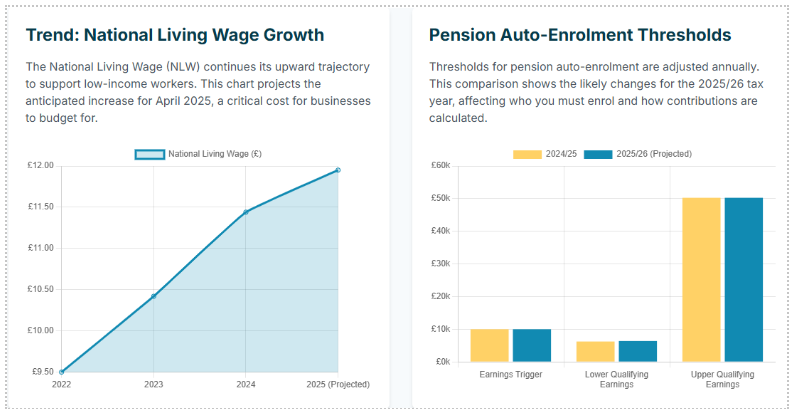
The 2025 legislative agenda includes more than just tax rates. It also contains new employee benefits. This reinforces the importance of integrated HR and payroll management. The minimum wage will increase for those aged 18-20, but apprentices and those under 18 years old will receive only $7.55 per hour. The introduction of the Statutory National Pay and Leave is a significant change. Parents are now able to take up to twelve weeks’ leave if their baby requires specialist neonatal care. Statutory rate of pay for parents is PS187.18, or 90% of the average weekly wage, whichever amount is lower.
These new entitlements differ from other forms of parental leave and must be incorporated in this shift. This shift requires businesses to have a transparent, documented process for handling such requests, showing that compliance extends beyond a simple calculation and requires a thoughtful review of internal span data-contrast auto HR policies span n data-contrast auto. Businesses must have a documented, clear process to handle such requests. This is not just a simple calculation, but it demonstrates that compliance goes beyond a simple calculation. Business owners must prepare to deal with these new entitlements in light of the payroll law change of 2025. They should also ensure that they have updated their payroll systems according to the latest payroll legislation.
Key UK Payroll Rates and Thresholds for 2025/26
| Category | Detail | Weekly Rate | Monthly Rate | Annual Rate |
|---|---|---|---|---|
| National Living Wage (21+) | Hourly Rate | N/A | N/A | £12.21 |
| National Minimum Wage (18–20) | Hourly Rate | N/A | N/A | £10.00 |
| Apprentice/Under 18 | Hourly Rate | N/A | N/A | £7.55 |
| Lower Earnings Limit (NI) | Threshold | £125 | £542 | £6,500 |
| Primary Threshold (NI) | Threshold | £242 | £1,048 | £12,570 |
| Secondary Threshold (NI) | Threshold | £96 | £417 | £5,000 |
| Employer NI Rate | Contribution | 15% (above secondary threshold) | 15% | 15% |
| Employee NI Rate | Contribution | 8% (up to UEL) | 8% | 8% |
| Employment Allowance (EA) | Maximum Claim | N/A | N/A | £10,500 |
| Statutory Sick Pay (SSP) | Per week | £118.75 | N/A | N/A |
| Statutory Maternity/Paternity Pay | Per week | £187.18 or 90% of AWE | N/A | N/A |
Case Study 1: UK SME: Controlling NI Cost Increases & “Hours Worked” Risk
Client: Emma Clarke, Managing Director, Northbridge Creative Ltd (UK SME, 18 staff)
Snapshot:
With the jump to an employer NI rate of 15% and a reduction in the secondary threshold down to £5,000, Northbridge’s payroll costs rocketed, while also suffering as it grappled with HMRC’s new “hours worked” reporting in its RTI returns. Working with ECO Outsourcing, an integrated time-tracking and payroll system was introduced, employment allowance usage re-configured, and RTI data cleansed.
Client quote: “Before ECO Outsourcing, anytime we ran payroll, it was like gambling. We’ve not only had our NI costs control, and accurate ‘hours worked’, but I haven’t had to think about that letter from HMRC dropping any time soon on my desk
. – Emma Clarke, Northbridge Creative Ltd
HMRC’s Enhanced Reporting: the ‘Hours worked’ mandate
A new, significant requirement for employers will be implemented starting April 6, 2020. Businesses will have to include the exact number of hours each employee worked in a pay period as part of their Real Time Information PAYE returns. Previously, this information was captured in broad bandings, but now it must be precise. Employees paid hourly must report the exact number, including overtime hours. If a salaried employee has a contract that specifies x number of hours, this figure must be reported, along with any overtime hours. When an employee’s salary is not determined by the number of hours worked, as in the case of a director’s, then the hours reported can be “nil” with a description. HMRC has a new strategic direction with this mandate, which aims to improve the enforcement of the National Minimum Wage.
HMRC systems can automate large-scale checks of compliance by collecting detailed data about hours worked and the pay received. The systems can perform a digital audit and flag up any discrepancy when an employee’s salary is below the minimum statutory amount when divided by reported hours. Businesses that still use manual processes or are using outdated software will be exposed to a higher level of risk, since a simple error in data entry in a spreadsheet could result in an inquiry about compliance. This mandate highlights the importance for SMEs to have a robust, accurate time-tracking system, which can collect, verify and report this new data.
Businesses must now be aware of changes to payroll 2025. This is especially true for changes to payroll tax and changes in payroll in April 2025. HMRC systems will be able to audit compliance automatically. Changing providers of payroll mid-year can also be riskier. Off-payroll Working Rules, also known by the acronym IR35, are designed to ensure individuals who provide services via a personal service company, or PSC, pay tax at a similar level to that of a traditional employee. 2025 will not be a complete overhaul of changes to payroll legislation. Instead, they are being fine-tuned in order to address concerns and redistribute administrative burden.
The “small company exemption” is the most significant change. The financial thresholds for defining a small business will be increased from April 6, 2020. The threshold for turnover will grow from PS10.2 million to PS15,000,000, and that of the total balance sheet from PS5.1 million to PS7.5,000,000. The third criterion, averaging 50 or fewer employees, remains unchanged. This change will have a significant impact on IR35 responsibilities. The company that was previously between the old threshold and the new threshold and therefore had to determine a contract’s status will now be reclassified as a “small” business and exempted from this requirement
The responsibility for IR35 is now transferred to the contractor’s PSC. This reduces the administrative burden on a growing group of businesses. This is a relief to clients, but it also places an additional burden on contractors, who will have to be more vigilant with their assessments and records. This change will affect engagements starting with the first applicable tax year, which, for most people, is April 20,27. HMRC is also addressing the problem of “double taxation” in an effort to make the tax system fairer. HMRC will now take into account any tax paid by a contractor via their limited company when calculating a client’s final tax bill. This will apply if the client incorrectly classified a contractor as “outside IR35” and HMRC challenges it. It is a relief to businesses as it reduces the financial risks and removes the frustration with the previous off-payroll rules.
Businesses should also be prepared for changes in payroll for 2025 and consider tools like QuickBooks payroll changes to make adjusting a payroll schedule easier. Businesses should be ready for changes to payroll in 2025 and use tools such as QuickBooks payroll adjustments for payroll schedule adjustments. Remember that companies using QuickBooks may need to modify payroll dates in QB online or modify payroll schedules in QB online in order to comply with these new regulations. Also, make sure that the Change Payroll Bank Account in QuickBooks has been managed according to the latest reporting requirements. It is important to review all 2025 payroll adjustments in detail as the changes unfold. VAT and payroll adjustments should be reviewed together to ensure alignment with the upcoming tax changes.
The US payroll and tax environment in 2025
The US operates based on a calendar year. While the UK tax system is driven by the new taxation year, it is the opposite in the United States. The 2025 US payroll landscape is marked by targeted adjustments, rather than a broad-scale reform. There is also a strong focus on digital compliance.
Federal tax and wage base adjustments
FICA tax is the collective name for federal taxes that cover Social Security and Medicare. These changes will have a direct impact on businesses and employees. Both the employee and employer will continue to pay the same Social Security tax of 6.2%. The wage base limit, which is the maximum amount that an employee can earn before being subjected to this tax, has been raised from $168.600 to $176.100. This change will have a direct impact on your finances. A business that has employees who earn more than the previous limit will be required to pay the 6.2% Social Security Tax on an additional $7.500 of wages.
The extra cost per employee is $465 for the business as well as the individual. Both the employer and employee will continue to pay Medicare tax at 1.45%, without any wage limit. Also, the additional Medicare tax of 0.9% on employees who earn more than $200,000 remains in place. It is important that SMEs update their Payroll system to reflect these new thresholds to avoid under-withholding or compliance issues. Businesses should also review bookkeeping to ensure that all payroll updates are aligned with these changes and to prevent errors in tax returns.
Key US Payroll Tax & Contribution Limits for 2025
| Tax Type | Contribution Rate | Wage Base Limit |
|---|---|---|
| Social Security (Employee) | 6.2% | $176,100 |
| Social Security (Employer) | 6.2% | $176,100 |
| Medicare (Employee) | 1.45% | No Limit |
| Medicare (Employer) | 1.45% | No Limit |
| Additional Medicare (Employee) | 0.9% | Over $200,000 |
| Household Employees FICA Threshold | N/A | $2,800 |
| Election Workers FICA Threshold | N/A | $2,400 |
Case Study 2: US Employer: Reacting to FICA & E-Filing Threshold Adjustments
Client: Daniel Lopez, CFO, Horizon Field Services Inc. (multi-state US employer; 35 employees)
Snapshot:
Horizon Field Services had a lot of manual processes and many spreadsheets. However, with the increase in the Social Security wage base to $176,100 and the IRS dropping the e-filing threshold to 10 information returns, the business faced significant underwithholding exposure and late or noncompliant filings. ECO Outsourcing walked them through automating payroll software and centralizing their federal, state, and local compliance.
Client quote: “The 2025 payroll changes could have overpowered our small team. WITH ECO there’s only one automated process, so we never need to firefight – as a result, we make every FICA and e-Filing deadline, without fail.”
Daniel Lopez, Horizon Field Services Inc.
2.2 Lowering the threshold for digital compliance
The expansion of the IRS electronic filing mandate will be a major change for US businesses in 2025. The threshold for electronic filing is now 10 returns or more, instead of 250. This rule is applicable to many forms, including W-2s and Forms 1099, as well as the quarterly federal tax return (Form 941). It may be perceived as a relief that the IRS clarified many of the common payroll forms, and federal income tax tables for Tax Year 2020 will remain unchanged. Businesses with fewer than 10 employees who previously used manual paper-based reporting must now switch to a digital system. To ensure compliance, companies must invest in secure payroll software and implement new internal processes.
Additional US Changes: An Expanding Web of Regulations
Businesses must deal with complex regulations that are constantly evolving, in addition to federal tax filing and reporting mandates. The Department of Labour has now fully implemented its final rule regarding employee classification. Businesses are required to review contracts and working relationships in order to avoid costly misclassification mistakes. A second important change is that the salary threshold for white-collar exempt workers will increase to $1,128 a week on July 1, 2025. The resumption of federal student loan garnishment collection adds an administrative burden to businesses. Businesses with remote workers face a complex set of regulations, both state-wide and locally. These multiple challenges show the limitations of manual systems and the need for automated, integrated software.
Proactive Compliance for Small Businesses
High Costs of Non-Compliance: Why Automation is the Solution
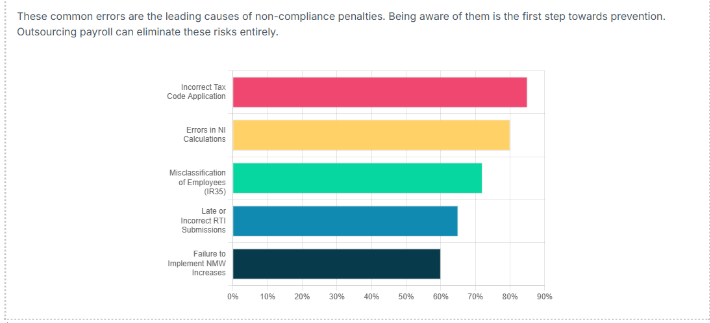
Unprepared businesses face significant risks as the payroll and compliance landscape changes. According to research, 84% of small-business owners confessed to having made payroll mistakes. The errors are usually a result of outdated manual processes. A simple typo on a spreadsheet could now trigger an audit by the government. The high costs of non-compliance highlight the need for an urgent strategic shift. Automation will help close this gap. Modern payroll software will help you to protect yourself from the increasing risks of non-compliance.
Strategic Compliance Checklist 2025
Businesses should use the following checklist to implement a proactive strategy for compliance.
- Update your Systems: Make sure that you have updated all of your systems to include the new tax rates and thresholds. Also, make sure that any software used for payroll is set up with the latest statutory pay figures, as well as new thresholds.
- Audit your Workforce Classifications: Review all employee classifications and independent contractor classifications based on new DOL regulations.
- E-filing: Prepare for electronic filing if your business files more than 10 returns.
- Revise and Review Policies: Update employee manuals, contracts, and HR policies.
- Improve Data Security: Implement robust measures to protect payroll information.
- Automated Time-Tracking: Implement a system to accurately track hours worked in order to comply with the HMRC report mandate.
- Schedule Regular Payroll Audits: Schedule regular payroll audits in order to identify and correct any errors.
Why automation is non-negotiable
The benefits of automated payroll software will only increase as legislation grows more complex. Automated solutions are able to track and apply regulatory updates in real-time, ensuring that all calculations from tax withholdings and statutory payments are accurate and current. The high risk of human error that is associated with manual data input is eliminated. Automated systems are also able to streamline important tasks, such as tax filings and deposits, directly with the tax authorities. Integrating payroll into time-tracking systems and HR software ensures that data such as hours worked, which HMRC requires, is accurately captured and reported without any additional manual intervention. Modern software improves security through the use of encrypted environments that are controlled by access.
Demystifying Common Payroll Concepts
The change in nonfarm payrolls
The changes in nonfarm payrolls are a popular economic indicator published by the US Department of Labor. The number of new or lost jobs in the US economy is measured, excluding farmworkers and certain other employees. A positive in the nonfarm Payroll indicates a growing economy. This can lead to increased consumer spending and wage inflation. This data can influence economic forecasts and have an impact on financial markets.
Navigating Day-to-Day Payroll Tasks
It can be difficult to manage payroll tasks on a daily basis, especially if you change payroll providers in the middle of a year. Businesses must secure the transfer of important data such as earnings for the year, tax withholdings, and employee information. Changing the payroll bank account is another common task. It is easy to adjust payroll dates on most payroll software platforms, including QuickBooks, by changing the pay date before processing Payroll. Businesses can also modify payroll schedules in QuickBooks Online through the payroll settings menu. Businesses must delete or void incorrect paychecks when making changes to Payroll submitted, for example, if it is changed too far in the past.
These adjustments may affect tax filings or incur additional fees.
How eco outsourcing can help your business thrive
The 2025 Payroll landscape is complex and presents challenges to SMEs. ECO Outsourcing is a UK-based firm that offers Payroll Management Services to ensure compliance with legislative changes. These include the UK’s new NI limits and HMRC’s mandate on hours worked, as well as the US’s Social Security wage base increase and e-filing requirements. They stay up to date on the latest regulations to eliminate late payments, incorrect calculations, and penalties for non-compliance. ECO outsourcing offers HRM (Human Resource Management) to help businesses align their internal policies to new laws, such as Neonatal pay or the right to request flexibility in working. Outsourcing offers a range of solutions to help businesses focus on their core operations, while also ensuring that back-office functions and services are managed with accuracy, security, and expertise.
Case Study 3: SME Doing Business Across Borders Going From Manual Payroll Services to Fully Automated Compliance
Client: Rebecca Shaw, COO, Global Tech Support Solutions (UK/US operation with 22 staff in total across both territories)
Snapshot:
Global Tech had business activity in both the UK and the US and was attempting to address NIC changes, HMRC’s new RTI “hours worked” criterion changes, US (FICA) thresholds, and DOL classification rules using two separate, inefficient manual processes. Mistakes, redundant information, and lost updates abounded. ECO Outsourcing consolidated UK and US payrolls into a single BPO-led process, harmonized HR policies with new statutory leave regimes, and carried out recurring payroll audits.
Client quote: “ECO Outsourcing made payroll no longer our most significant compliance headache and introduced a consistent, well-governed approach into the UK and US.”
– Rebecca Shaw, Global Tech Support Solutions
FAQs
Yes, employers can alter payroll dates. However, they cannot do this to avoid paying for overtime or manipulating the workweek. Federal Law and specifically the Fair Labour Standards Act does not prohibit employers from changing payroll dates, but it does require that wages are paid on time. Many states have added regulations, such as giving employees advance notice.
A QuickBooks submission of Payroll cannot be altered directly. The original paycheck will need to be voided, deleted, and a corrected one created. The process could incur an extra fee.
When you change jobs, your number of Payroll will also change. A payroll is a unique internal identifier assigned by an employer to an employee to process their wages. This is different from the PAYE reference numbers (in the UK) or Employer ID Number (EIN), which are assigned to companies for tax purposes.
To change the pension contribution of an employee in Payroll, an employer needs to edit the employee’s record, select the Pensions tab, and then Manage Schemes. The pension scheme can then be edited by adjusting the values for Employee Contributions and Employer Contributions. If your scheme is manual, you must enter the payment amounts directly into the Enter Payments section.
To change the tax code in Payroll 50, an employer needs to go to Settings and select Configuration. Then click the Codes of Tax. This menu allows you to edit an existing tax code or create a new one. In the Edit Tax Code window, the employer can modify the tax rate as well as other settings.
The employer can change the employee’s frequency of pay in Payroll Manager by navigating to Utilities and selecting Change an employee’s frequency. Pay frequencies can only be changed at certain times of the year. For example, week 13 coincides with month 3. The pay frequency of an employee can only be changed once a year.
To modify the payment date in Xero, the employer will need to create a new frequency of pay and assign it to the employees. An employer cannot edit an existing pay frequency, whether it is assigned to an employee or has been used for a previous pay run. Before assigning the new pay frequency to an employee’s record, it should have a unique name as well as the desired pay period.