
The Strategic Imperative of Payroll for UK Small Businesses
Payroll is a foundational function for any business, extending far beyond the simple act of paying employees. First, it seems simple: hire a few people, pay them at the end of the month, and move on. But very quickly, it becomes clear that payroll management for small businesses is not just about paying wages; it’s tied to compliance, staff morale, and even the reputation of your company. Ask any café owner in London or tradesman in Birmingham, and they’ll tell you: figuring out how to manage payroll for small businesses is one of those jobs that can trip you up if you don’t take it seriously. The numbers must be right, HMRC must be satisfied, and your employees must trust that their pay will arrive without errors or delays. When you get it right, things run smoothly.
That’s why managing payroll for small businesses must be seen as a priority, not just paperwork. The reality is that small firms don’t have the luxury of entire finance departments like big corporations. Owners often juggle sales, marketing, customer service, and then somehow try to keep payroll organized late at night. That’s where small business payroll solutions come into play.
Whether it’s a simple software package or a fully automated payroll UK system, technology has made life easier. And for some owners, outsourcing payroll is the most practical route, especially when time and compliance pressures build. This guide is designed to strip away the confusion around setting up payroll for a small business. We’ll walk through the basics, highlight common mistakes, look at software and outsourcing options, and share best practices that UK SMEs can actually apply. Think of it as a roadmap, not to make payroll exciting, but to make it reliable, stress-free, and part of the foundation your business can grow on.
Case Study: London café that stabilised payroll with Eco Outsourcing’s setup support. A small café in London was paying a mix of hourly and part-time staff, but overtime, tax codes, and pension deductions were repeatedly getting messy. Staff were raising concerns, and the owner was spending late nights correcting payslips. Eco Outsourcing stepped in to set up PAYE properly, standardize starter/leaver checks, and implement a simple payroll workflow with RTI-ready reporting. Within weeks, pay calculations became consistent; payslips were clearer, and payday no longer triggered last-minute fixes. The own
er kept control of staffing decisions while payroll ran smoothly in the background.
Part 1: The Foundational Concepts of UK Payroll
Deconstructing Pay: Gross Pay, Deductions & Net Pay
A small business owner learns early in the game about payroll: The number on a contract is not that number you find in an employee’s bank account. Payroll is rooted in gross pay: the total earnings from a wage or salary before anything is deducted. If you own a café and pay baristas by the hour, that’s hours worked multiplied by their hourly wage, plus overtime when they work extended shifts. If you have a graphic designer on a salary, it is their annual salary divided by all the pay periods. Easy enough, until the deductions start kicking in.
In the UK, those deductions are largely managed under HMRC’s PAYE system, and they’re not optional. You’ll see:
Income Tax (PAYE): According to the tax codes. For 2024/25, every individual has a £12,570 personal allowance before tax is applied.
National Insurance Contributions (NICs): Paid by employer and employee, and the rate varies for high earners.
Student Loan Repayments: Deducted automatically when your income reaches the repayment threshold.
Pension Contributions: Auto-enrolment sees the majority of employees go into a workplace pension, where your firm also contributes out of your pay.
Judicial Descriptions: These could be child support or other debts that have to be garnished.
And in addition to that, some workers opt for extra voluntary deductions. Perhaps there are university fees to pay, gym memberships or private medical coverage; many things are tied up with work. Everything after all that is the net pay number staff care about, because that’s what lands in their account. And for anyone figuring out how to do payroll for a small business, this breakdown is essential. Miss an automatic pension contribution, get the tax code wrong, and you can face complaints and loss of trust as well as HMRC penalties.
This is why more and more owners are relying on small business payroll solutions or modern payroll management software for small businesses. Rather than spending nights wrestling with spreadsheets, the software does the grunt work, checking tax codes, calculating contributions and generating payslips. Others choose payroll management services for small businesses, outsourcing the task to providers that are fluent in the rules. For SMEs, it isn’t so much a question of saving time (although they do) as going to bed at night secure in the knowledge that their staff are being paid for what they should be, and that the business is compliant.
The UK Payslip: A Guide to Required Information
For many employees, the payslip is more than a slip of paper or a PDF attachment; it’s proof that their employer values transparency and accuracy. For small firms, issuing a clear payslip is not just good practice; it is a legal requirement in the UK. Under current regulations, every payslip must spell out the essentials, from gross pay to net pay, along with a full breakdown of deductions. Getting this right is part of building trust, something that is just as important as compliance.
So, what exactly has to be on a UK payslip? At a minimum, it should include:
- Employee’s personal details and payroll reference number.
- The tax period and the employee’s HMRC tax code.
- National Insurance (NI) number.
- A breakdown of pay, basic salary or hourly wage, plus any overtime, bonuses, or commission earned.
- Itemized deductions including tax, NI, pension contributions, and student loan repayments.
When payslips are clear and easy to read, they signal professionalism. Staff can see exactly how their pay is worked out, which avoids confusion and unnecessary disputes. On the other hand, vague or inconsistent payslips create frustration and can erode confidence in the business. For owners learning how to manage payroll for a small business, this level of transparency is a simple but powerful way to keep employees engaged and satisfied.
In practice, many SMEs now rely on small business payroll solutions or payroll management software for small businesses to generate compliant payslips automatically. The best systems not only calculate deductions correctly but also format payslips in a way that staff can easily understand. For startups and smaller firms trying to build credibility, professional-looking payslips are often underestimated, but they can make a big difference in staff morale.
The First Step in Payroll: Defining Employment Status
Before setting up payroll, every small business must decide if a worker is an employee or a contractor. Get this wrong, and HMRC fines can follow. For those learning how to manage payroll for small businesses, this is the first and most important step. Employees work under your direction, are paid through PAYE, and have Income Tax and National Insurance deducted by the business. Freelancers or contractors, on the other hand, handle their own taxes through self-assessment. The tricky part is the IR35. These rules stop businesses from calling someone a contractor when they are really an employee. Misclassification can lead to heavy penalties. To stay safe, many owners use payroll management services for small businesses or a payroll system for startups to get it right from the start.
Part 2: The End-to-End UK Payroll Process
Phase 1: Setting Up Your Payroll Scheme
Getting payroll right does not start on payday; it begins with the systems and registrations you put in place beforehand. For small business owners, the setup stage is where compliance is won or lost.
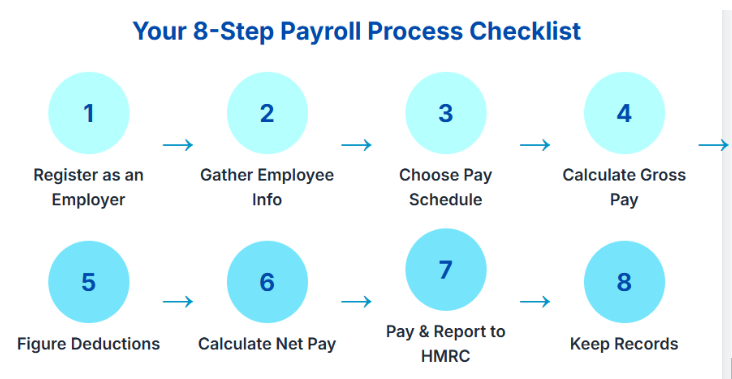
Step 1: Register as an Employer with HMRC
Before you pay your first member of staff, you need to register as an employer with HMRC. Once registered, you will receive a PAYE Reference and Accounts Office Reference number. These are not just formalities; they are essential identifiers you will use every time you report payroll. Even if you are the only director and plan to pay yourself a salary, registration is mandatory. Without it, you can’t legally deduct Income Tax or National Insurance through PAYE.
Step 2: Decide How to Run Payroll
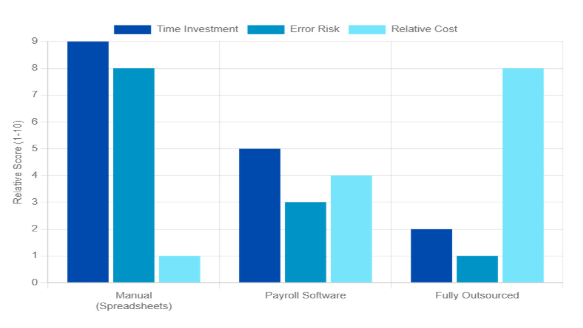
The next choice is whether you will manage payroll yourself, use software, or outsource it. Each approach has pros and cons:
- Manual Payroll: Some startups try the DIY route with spreadsheets. It may feel cheap, but it’s risky. Errors in tax or National Insurance can mean penalties from HMRC and unhappy employees when wages are wrong.
- Software-Based Payroll: Most SMEs now lean on HMRC-recognised software. It automates calculations, produces digital payslips, and helps you stay compliant without spending hours on admin. Popular systems fall under the category of payroll management software for small businesses, and many even offer freeversionsso you can test before committing.
- Outsourced Payroll: For business owners short on time, outsourcing can be the safest bet. A payroll management provider for small businesses handles everything from tax filing to reporting. You lose some direct control, but you gain expertise and peace of mind. Many owners consider this one of the most practical payroll management services for small businesses, especially once they start growing.
Step 3: Gather Employee Information Securely
Before payroll can run smoothly, you’ll need the right employee details. That means their full name, National Insurance number, and current tax code (found on a P45 or HMRC starter checklist). Storing this information is not about organization; it is a legal responsibility under UK data protection rules. New employees must be told how their information will be used and who it will be shared with. These records need to be kept for at least three years in case HMRC decides to carry out an inspection. For SMEs, careful setup saves headaches later. Whether you are running payroll through a simple payroll system for startups or outsourcing specialists, getting these first steps right is the foundation of reliable payroll management for small businesses.
Phase 2: Keeping Payroll Running Each Pay Cycle
Once the groundwork is finished, payroll shifts into a routine cycle. For small businesses, this cycle repeats every week or month, and while it becomes familiar, it still demands accuracy at every stage.
- Tracking Hours and Working Out Pay
For hourly staff, the first step is always time. Did someone stay late? Pick up extra shifts? All that needs to be logged in. Some shops still jot hours on paper, but most SMEs now lean on digital timekeeping apps to avoid mistakes. Once hours are in, you can work out gross pay by multiplying time worked by the hourly rate. For salaried workers, it’s simpler to divide the yearly figure into monthly or weekly portions.
- Handling Deductions and Employer Costs
Next comes the part many owners find tricky: deductions. From gross pay, you’ll need to calculate Income Tax and National Insurance based on the employee’s tax code. Employers also pay their own share of Class 1 NI. Some smaller firms can claim the Employment Allowance, which helps offset this cost. On top of that, there are pension contributions, student loan repayments, and sometimes extras like union fees. For anyone still learning how to manage payroll for small businesses, this stage can feel overwhelming, but it’s also the point where compliance matters most.
- Payslips and Transparency
When everything is tallied, each employee must receive a payslip on or before payday. The payslip is more than a formality; it shows the breakdown of pay, deductions, and the net pay staff actually take home. Clear payslips mean fewer questions and less tension. Confusing ones? They almost always cause disputes. That’s why many owners invest in payroll management software for small businesses or work with a payroll management provider for small businesses to automate this part.
For SMEs, consistency is everything. Whether you’re using small business payroll solutions, outsourcing, or trying out a payroll system for startups, the goal is the same: staff get paid on time, correctly, and with full transparency. Do that, and payroll shifts from a burden into a routine that quietly supports trust and loyalty.
Case Study: How Eco Outsourcing kept a growing SME’s payroll accurate every pay cycle
A growing UK-based services SME was running payroll monthly for a mix of salaried and hourly staff. As overtime increased and pension deductions kicked in, small errors started creeping in. Hours were sometimes logged late, deductions were double-checked manually, and employees regularly asked questions about their payslips. Payroll was technically “working,” but it was taking too much management time and creating unnecessary friction.
Eco Outsourcing took over the day-to-day payroll cycle, introducing a structured cut-off process for timesheets, automating gross-to-net calculations, and standardising deductions for tax, National Insurance, pensions, and student loans. Every pay run went by the book: hours verified, deductions processed, payslips checked and payments made as promised. Now, staff receive regular, clear payslips, and payroll-related questions have plummeted; the owner no longer has to laboriously check the sums every month. Payroll was consistent and reliable, enabling staff trust while allowing the leadership team to focus on creating instead of admin.
Phase 3: Reporting and Paying HMRC
One of the biggest shifts in recent years has been HMRC’s move to Real-Time Information (RTI). For small business owners, this means payroll can’t be tucked away and dealt with once a month or at the end of the quarter. Instead, every payday requires reporting to HMRC, on or before the day staff are paid. It’s a rule that makes old-fashioned spreadsheets risky at best and non-compliant at worst. For many SMEs, this is the point where payroll management software for small businesses or a payroll management provider for small businesses becomes less of a luxury and more of a necessity.
Two main reports sit at the heart of the process:
- Full Payment Submission (FPS): This is the core return. It’s sent every payday and lists what each employee was paid, alongside all deductions for tax and National Insurance. It also updates HMRC when new employees join or when someone leaves.
- Employer Payment Summary (EPS): This is the adjustment tool. It tells HMRC about reductions to your PAYE bill, for example, statutory maternity pay or the Employment Allowance. It also covers months when no staff were paid. EPS reports must be filed by the 19th of the following month.
Once these are in, the money has to follow. For monthly pay runs, tax and NI must be paid by the 22nd of next month. Businesses that report quarterly follow the same deadline, but at the end of each quarter. Missing payments or reports risks penalties and interest charges, which can be painful for a small firm’s cash flow. What’s important to understand is the link between the FPS and EPS. The FPS essentially tells HMRC what you owe, while the EPS allows you to offset that bill by claiming allowances or reimbursements.
Miss the EPS, and you could end up overpaying. For small firms trying to balance budgets, that’s money better spent on growth than sitting in HMRC’s account. For anyone figuring out payroll management for small businesses, this reporting phase is often the trickiest to handle manually. Automating through a payroll system for startups or outsourcing specialists can prevent errors, save time, and protect cash flow.
Case Study: Birmingham trades business that fixed RTI compliance with Eco Outsourcing
A growing trades business in Birmingham was missing RTI deadlines because FPS submissions were being done after payday, leading to HMRC notices and avoidable stress. Eco Outsourcing restructured their pay cycle around “submit FPS on or before payday,” handled EPS adjustments correctly, and built a monthly payroll checklist to prevent repeat issues. The result was consistent RTI reporting, fewer compliance worries, and better visibility over PAYE liabilities, which helped the owner plan cash flow and quote jobs with more confidence.
| Full Payment Submission (FPS) | Employer Payment Summary (EPS) | |
|---|---|---|
| Purpose | To report employee, pay, deductions, and tax information to HMRC. | To claim reductions on your PAYE bill or report that no employees were paid. |
| What it Includes | Detailed employee data (name, NI number, tax code), gross pay, deductions (tax, NICs, pensions), and year-to-date figures. | Reclaimed statutory payments (e.g., SMP, SSP), Employment Allowance, Apprenticeship Levy, and a "nil payment" declaration. |
| When to Submit | On or before each payday. | By the 19th of the following tax month. |
| When to Use it | Every time you pay an employee, including new starters and leavers. | When you have a reduction to claim, or if no employees were paid in a tax month. |
Part 3: Deep Dive into Key Compliance Areas Navigating Pension Auto-Enrolment: Your Duties as an Employer
The UK’s auto-enrolment legislation imposes a legal duty on every employer to enroll eligible staff into a workplace pension scheme. The Pensions Regulator oversees this process and can issue fines for non-compliance.
Employers must automatically enroll workers who:
- Are not already in a workplace pension scheme.
- They are aged between 22 and State Pension age.
- Earn more than the minimum earnings threshold, which is £10,000 for the 2025/26 tax year.
Both the employee and the employer are required to contribute to the pension. The total minimum contribution is 8% of the employee’s “qualifying earnings,” with a minimum of 3% paid by the employer and 5% by the employee (which includes tax relief). “Qualifying earnings” are defined as earnings between £6,240 and £50,270 for the 2025/26 tax year. A business’s pension duties are not a one-time event. Employers have a legal duty to assess and automatically re-enroll any eligible employees who have opted out of their pension scheme every three years, in a process known as the triennial review. This ongoing obligation highlights that a robust, automated payroll system is essential for long-term pension compliance.
Essential HMRC Payroll Forms Every Employer Should Know
Payroll in the UK isn’t only paying staff each month; it also comes with paperwork that marks key moments in the employment journey. For a small business, keeping on top of these forms is crucial. They protect employees, keep HMRC satisfied, and save you from messy corrections later. For anyone learning how to manage payroll for small businesses, these forms are part of the backbone of compliance.
- P45 – When an Employee Leaves
When someone leaves your company, you’re required to hand them a P45. It lists their gross pay so far and the tax they’ve already paid that year. Their next employer relies on it to get their tax code right from day one. Without a P45, new starters can easily get placed on an emergency tax code and overpay, which usually leads to unhappy phone calls.
- P60 – At Year-End
If an employee is still with you on 5 April, you must issue them a P60. This form totals all their earnings and deductions for the tax year. Staff often need it for mortgage applications, personal tax checks, or loan approvals. For business owners, issuing accurate P60s on time shows professionalism and avoids complaints later.
- P11D – Declaring Benefits in Kind
Not everything is taxed through payroll. If you’ve offered perks like a company car, private health insurance, or an interest-free loan, they must be reported using a P11D. HMRC treats these benefits as taxable, and staff may owe extra tax depending on what is provided.
Every one of these forms is linked back to your day-to-day submissions. A P60 will only be correct if each Full Payment Submission (FPS) across the year is accurate. One mistake in payroll reporting can snowball into bigger issues at year-end. That’s why many SMEs now use small business payroll solutions or hand the process over to a payroll management provider for small businesses. It reduces errors, saves time, and ensures no one ends up out of pocket.
Record-Keeping and HMRC Audits
If there’s one habit every small business needs to take seriously, it’s payroll record-keeping. This isn’t just a “good admin”, it’s a legal requirement. Employers in the UK must hold on to detailed payroll records covering employee pay, deductions, tax code notices, and all reports sent to HMRC. You also need proof that the staff were paid at least the minimum wage. These records must be kept for at least three years after the tax year they relate to, and in practice, many accountants recommend keeping them longer.
The reason is simple: HMRC can and does run compliance checks. These PAYE inspections aren’t designed to catch you out, but if your records are incomplete or inconsistent, the process can quickly turn stressful. During an audit, HMRC will usually ask to see your payroll submissions, proof of payment, and any employee-related documents that explain how pay was calculated. Having everything organized not only makes the review faster but also signals professionalism. For SMEs learning how to manage payroll for small businesses, this is an area where good systems pay off.
Digital small business payroll solutions and modern payroll management software for small businesses can store payslips, FPS submissions, and deduction records automatically, giving you a paper trail at the click of a button. Businesses that outsource also benefit here, since a payroll management provider for small businesses will usually keep those records ready for inspection. The bottom line? Proper record keeping protects your business. It keeps you compliant, saves stress if HMRC ever comes knocking, and shows employees you take payroll seriously.
Case Study: How Eco Outsourcing helped a retail SME pass an HMRC payroll review with confidence
A small retail business with under 15 employees received notice of a routine PAYE compliance check from HMRC. Payroll had been run in-house using basic software, but records were scattered; some payslips were stored as emails, others on local drives, and pension documentation was incomplete. The owner was confident that staff had been paid correctly but proved it quickly became a concern.
Eco Outsourcing stepped in to centralise payroll records, consolidating payslips, FPS and EPS submissions, tax code notices, and pension reports into a single, audit-ready system. We reviewed historical payroll data, verified minimum wage compliance, and prepared a clear evidence pack aligned with HMRC’s audit checklist. When HMRC requested documentation, everything was available within hours, not days.
The review was completed without penalties or follow-up queries. More importantly, the business moved forward with a structured record-keeping process, removing the anxiety around future inspections and freeing the owner from last-minute document searches.
Part 4: Should You Keep Payroll In-House or Outsource It?
Every small business hits this decision sooner or later: do you run the payroll yourself or hand it to someone else? The answer isn’t the same for everyone. It comes down to time, budget, and how much control you want over the process.
Keeping Payroll In-House
Plenty of owners like to keep things in their own hands, usually with the help of software. The appeal is obvious, you keep control of sensitive employee and financial data, and you can see what’s happening at every stage. Modern payroll management software for small businesses does a lot of heavy lifting. It calculates tax and National Insurance, updates when HMRC rules change, and even creates payslips automatically. Some of the better small business payroll solutions also link with accounting systems, so you’re not juggling numbers across different platforms. For startups, this can be a neat way to stay organized without spending too much time. Payroll gets complicated as soon as you add overtime, pensions, or different pay structures. If you’re short on admin support, doing it all yourself can quickly become a headache.
Outsourcing Payroll
The alternative is outsourcing. By using a payroll management provider for small businesses, you hand over the entire job to specialists. They deal with calculations, payments, deductions, and compliance. For a busy owner, this can be a huge weight off your shoulders. The upside is obvious: you get expert knowledge, reliable systems, and often better data security than you could set yourself up. Outsourced payroll management services for small businesses also scale easily, so as you grow, you don’t need to rethink the process. The downside is the cost. It’s usually more expensive than software, and you give up a bit of direct control. Some owners don’t mind; others find it harder to let go.
Making the Right Choice: A Decision Framework
The decision between an in-house and an outsourced payroll system depends on a business’s specific needs, including its size, the complexity of its payroll, its budget, and its internal resources. When making this decision, it is important to consider the total cost of ownership, which includes not only the direct cost of the software or service but also the indirect costs of human error, the time spent on administrative tasks, and the lost opportunity to focus on revenue-generating activities. The cheapest solution on paper may not be the most cost-effective in the long run. A hybrid approach is also a viable option, where a business manages day-to-day payroll in-house using software but outsources more complex tasks or year-end filings to an external specialist.
Case Study: Service SME that scaled payroll without hiring internally using Eco Outsourcing
A professional services SME started with basic payroll software, but as headcount grew, payroll became harder to manage and pensions, leavers/joiners, variable pay, and HMRC reporting were taking too much time. Eco Outsourcing took over end-to-end payroll processing, ensured auto-enrolment assessments were handled correctly, and maintained RTI submissions for each cycle. The business scaled its team without adding internal admin burden, employee pay queries dropped, and leadership reclaimed time for client work and growth.
A Look at Popular UK Payroll Software
For businesses that choose the in-house approach, a wide range of HMRC-recognized software is available to simplify the process.
- HMRC’s Basic PAYE Tools: This is free software provided by HMRC for businesses with fewer than 10 employees. It can perform most payroll tasks, including calculating tax and NI, but it has limitations and is not suitable for bookkeepers or agents.
- Free Payroll: A cloud-based, free software that handles tax reporting, auto-enrolment, and more. The company’s business model is based on earning a portion of fees from pension contributions managed through their platform.
- Paid Software: Leading paid platforms for UK small businesses include Sage Payroll, Bright Pay, Xero, and QuickBooks Payroll. These solutions offer a variety of features, including automatic pension assessments, RTI submissions, and integrations with other accounting and HR systems. Some providers, like ADP, also offer a managed payroll service in addition to their software.
| Software | Best For | Starting Price (per month) | Key Features |
|---|---|---|---|
| HMRC's Basic PAYE Tools | Very small businesses (<10 employees) with simple needs. | Free | Tax/NI calculation and reporting to HMRC. |
| Sage Payroll | New businesses balancing payroll with basic HR needs. | From £10 | RTI submissions, pension enrolments, and basic HR features. |
| Bright Pay | Affordability and versatile pay frequencies. | From £8.25 | Supports weekly, monthly, and other pay frequencies. |
| Xero | Startups wanting an all-in-one accounting and payroll solution. | From £33 | Integrates accounting, payroll, and employee experience in one product. |
How Eco Outsourcing Supports Small Businesses with Payroll
Choosing between in-house payroll and outsourcing can feel like a tough call for many SMEs. That’s where Eco Outsourcing steps in. We specialize in helping small businesses simplify payroll by offering reliable, cost-effective solutions tailored to their needs. For owners still figuring out how to manage payroll for small businesses, we provide hands-on support and systems that keep everything compliant with HMRC.
Whether you need help setting up a payroll system for startups or ongoing payroll management for small businesses, our team makes sure staff are paid on time, every time. Eco Outsourcing combines the best of both worlds: the flexibility of modern payroll management software for small businesses and the reassurance of expert guidance. Our specialists stay up to date with changing UK tax rules, handle reporting via FPS and EPS submissions, and ensure deductions such as pensions and student loans are managed correctly.
For businesses without the resources for a full in-house payroll team, our payroll management services for small businesses save time and reduce stress. We also make the process scalable so that as your workforce grows, your payroll runs just as smoothly. Most importantly, outsourcing payroll to Eco Outsourcing allows owners to focus on what matters most: running and growing their business. From cafés and retail shops to professional service firms, we have helped a wide range of SMEs build trust with employees by ensuring payroll is accurate, transparent, and fully compliant.
Client Testimonial
“Eco Outsourcing has been a game-changer for our payroll. RTI submissions are always on time, payslips are accurate, and we’ve stopped worrying about compliance. It’s taken a real weight off our team.”
— Operations Manager, UK SME
FAQs
In the UK, payroll taxes are handled through PAYE, which covers Income Tax and National Insurance. You begin with the employees’ tax code, which shows how much of their earnings is tax-free. For 2024/25, most people have a personal allowance of £12,570. Anything above that is taxed at the correct rate, while National Insurance is also deducted according to earnings. Employers must add their own NI contributions too. Many small firms use HMRC-approved payroll software to stay compliant.
There isn’t a single “best” payroll software because every small business has different needs. A café with five staff might be fine using HMRC’s free Basic PAYE Tools, while a growing agency could prefer something like BrightPay or Xero for automation and reporting. Sage is also popular with firms that want accounting and payroll in one place. The key is to choose software that’s HMRC-recognized, easy to run, and scalable as your business grows.
For a small business, calculating payroll taxes involves processing PAYE. Start with each employee’s gross pay, then apply their tax code to see what portion is tax-free. For most people in 2024/25, the first £12,570 isn’t taxed. Income above that is taxed at the correct band, while National Insurance is deducted based on earnings. Don’t forget employers also pay their own NI contributions. Many owners use payroll software to handle the calculations and automatically submit reports to HMRC.
Employee tax deductions in the UK are handled through PAYE. Each pay run, you start with gross pay and apply the employee’s tax code to calculate Income Tax. National Insurance is then deducted according to their earnings, along with any student loan repayments or pension contributions. Some staff may also have voluntary deductions, like union fees. The key is accuracy; mistakes frustrate employees and can trigger HMRC penalties. Most small businesses use HMRC-approved payroll software to keep deductions correct and compliant.
Yes. Since the auto-enrolment rules came into force, even the tiniest UK employers have had pension duties. If your staff are aged 22 or over, below State Pension age, and earning more than £10,000 a year, they must be enrolled. The payments come straight from their wages, and you’ll need to add your contribution as well. This applies whether you employ two or twenty people. Most owners find payroll software useful here because it automatically handles pension deductions.
Conclusion: Turning Payroll into a Strength
For most small business owners, payroll feels intimidating at first. But once the system is set up and the process becomes familiar, it stops being a burden. In fact, strong payroll management for small businesses can be a real asset. It protects you from HMRC penalties, reassures employees, and gives you a clear picture of your company’s finances. This guide has walked through the basics of setting up PAYE, running pay cycles, issuing payslips, and keeping accurate records. The big takeaway is simple: knowing how to manage payroll for a small business isn’t just paperwork.
It’s about consistency. Staff trust you when they’re paid correctly and on time. HMRC trusts you when your reporting is accurate. And you can trust the process to run smoothly once it’s in place. Different businesses take different paths. Some start small with payroll management software for small businesses, free trials, while others upgrade to paid systems as they grow.
Many eventually hand the responsibility over to specialists who offer payroll management services for small businesses,especially when time is short or compliance becomes too complex. There’s no single “best” option, only the one that fits your stage and priorities. The important thing is that payroll doesn’t have to stay stressed. With the right tools or support, it becomes just another reliable part of running your business. And when it’s handled well, payroll isn’t only about paying people; it’s about building trust, protecting your reputation, and laying down a stronger foundation for growth.