

Paying international contractors means following clear UK rules for cross-border worker payments. You can pay overseas contractors through banks or other trusted payment platforms.
The right method depends on cost, currency, records, and compliance. At first, confirm their correct working status before paying anyone overseas. You should also check where the contractor performs their actual work.
This guide shows you how to pay international contractors from the UK. At Eco Outsourcing, we help UK businesses pay contractors overseas every week. Our team handles the compliance so you can focus on business growth.
Why Are UK Businesses Hiring More International Contractors?
Many companies in the UK are now contracting with people in other countries to tap into a bigger talent pool. The use of remote working technology has made managing international teams much simpler than it used to be. In addition, the cheaper labor costs compel many companies to pay contractors in other countries.
44% of businesses in the UK plan on growing their teams in 2025 alone. Many companies in the UK have no choice but to turn to people outside of the UK due to talent shortages within the country. There are skills such as technology and creativity that are available worldwide.

What Are the Benefits of Contractor vs Employee Overseas?
A contractor setup has 4 main benefits for a growing UK business.
- Self-managing of taxes: Taxes and National Insurance are managed by contractors themselves.
- Payments in gross: The full payment is made without any deductions of PAYE or employer NIC.
- No employee rights: No holiday pay, sickness pay, or other entitlements.
- Flexibility of scaling: Flexibility in scaling of your workforce according to each project.
When Does IR35 Apply to Overseas Contractors?
IR35 is applicable when the contractor supplies his or her services using a limited company. Off-payroll employment rules can classify them as employees for tax purposes. Personal service company status needs to be examined in detail. Rules for hiring overseas contractors in the UK incorporate IR35.
What Steps Make an Overseas Contractor Payment Legal in the UK?
Legal payment to overseas contractors in the UK can be made by following some simple steps. First, ensure that the individual is indeed a contractor and not a disguised employee. Then pay through a safe method and keep every record for 6 years.
Here are 5 simple steps that one can take for every new contractor.
- Verify status: Ask whether the individual operates independently for multiple clients.
- Sign a contract: List the work and the price plus the due date.
- Get an invoice: It must show the name, date, and amount.
- Pay safely: Use a bank or a trusted app you can track.
- Keep records: Save all files in one safe place for 6 years.
These steps help you pay contractors overseas legally and avoid stress later. Also learn the main UK contractor payment rules before you send money.
What Legal Requirements Must UK Businesses Follow?
Verify the worker qualifies as a genuine contractor under UK law tests. IR35 rules may apply if the contractor works through a personal service company. Right to work checks are needed only if the contractor performs work inside the UK. Contracts must specify scope, deliverables, and payment terms clearly.
How Does UK Tax Law Treat Remote International Contractors?
Where the person lives and works decides which country taxes their income. Most overseas contractors pay tax in their own country and not here. That is true when they do all the work outside the UK. UK tax residency uses the 183-day test for time spent in the country.
International contractor tax rules in the UK change if the person works on UK soil. Income from UK-based work is also taxed differently under the source rules.
Overseas contractor tax obligations also depend on local laws in their home country. Your contractor must report their own income and pay their own tax there.
Remote work can also bring one more risk called a taxable base abroad. This can happen when your contractor acts like your local office overseas.
Signing deals on your behalf is one clear sign of that risk. Tax experts often call this a permanent establishment risk in many places. Ask a tax expert if your contractor holds that kind of power.
What Are Double Taxation Agreements?
UK has tax treaties with over 130 countries to avoid double taxation. Tax paid in one country offsets liability in the other country. Tax credit mechanisms prevent paying tax twice on income. International contractor tax relief in the UK is available through treaties.
Should You Deduct UK Tax from Overseas Contractor Fees?
UK businesses generally do not deduct tax from genuine overseas contractor fees. The contractor pays their own income tax in their home country instead. No PAYE deduction is needed for services done fully outside the UK. There are a few exceptions you should know about before you pay.
- Royalties: Payments for using patents or brand rights can face 20% UK tax.
- Construction: The Construction Industry Scheme applies to building work in the UK.
- Staff status: A worker who acts as staff may need payroll tax.
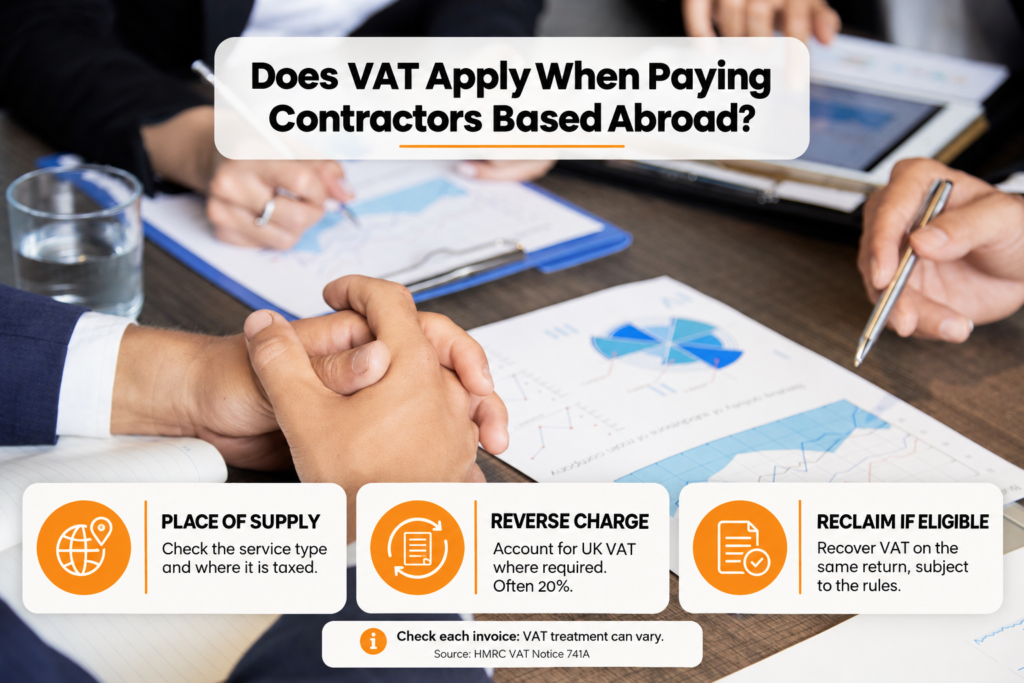
Does VAT Apply When Paying Contractors Based Abroad?
The VAT treatment will be based on the nature of the service and where it is provided. According to HMRC, there are various rules for various services depending on the place of supply of the service. In most cases, the rule of place of supply looks into the location of the customer.
VAT-registered UK firms often owe 20% VAT on services bought from abroad. This works through the reverse charge system on your normal VAT return. You can usually claim the same amount back on the same return. Do not treat every overseas invoice the same way for VAT purposes.
Which Payment Method Works Best for Overseas Contractors?
The best way to pay international contractors depends on payment size and frequency. Bank transfers suit large occasional payments made to a single contractor abroad. Payment platforms work better for frequent and smaller payments around the world. Contractor management tools are ideal for larger teams with 10 plus contractors.
Small businesses should focus on low fees and a very simple setup. Wise often offers strong rates for payments under ten thousand pounds each. Revolut business accounts also offer multi-currency features for free on some plans.
The given international contractor payment methods have clear strengths and a few limits. Below is a table that show the best way for businesses to pay international contractors.
| Method | Best for | Advantages | Disadvantages |
| Bank wires (SWIFT) | High-value occasional payments | Global reach and strong records | Slower, 1 to 5 days, and higher cost from FX plus fees |
| Wise | Regular international payments | Fair exchange rates and clear pricing | Limited coverage in some countries |
| PayPal | Speed and convenience | Widely used and instant transfers | Higher fees and currency conversion costs |
| Payoneer | Global freelancers | Many payout options and broad coverage | Recipient fees may apply |
| Contractor platforms | Managing many contractors | Central control and automated compliance | Service fees and platform dependency |
Important Note: Prices and speeds change often, so always check the live rates first.
How Can You Avoid Hidden Fees When Paying Contractors Abroad?
Hidden fees mostly come from poor exchange rates and not the listed charge. Banks often add a 2% to 4% markup on top of wire fees. On a £5,000 payment,t a 3% markup quietly costs your business £150. Paid every month, that small gap becomes £1,800 lost in one year.
Learn how to pay international contractors without hidden fees using this simple list.
- Ask for the mid-market rate and compare it with the offered rate.
- Check for fees on both ends of the transfer before you send.
- Pay in the contractor’s currency when the app shows a fair rate.
- Batch your payments once a month to cut the number of fees.
- Agree in writing who pays each bank fee before the work starts.
- Always ask contractors about receiving bank charges in their own country.
How Do You Record Overseas Contractor Payments in QuickBooks Online?
QuickBooks Online lets you track overseas bills in pounds or other currencies. Good contractor payment accounting UK habits always start with tidy monthly books. Multicurrency cannot be switched on later and may require a paid plan.
Here is how to pay international contractors in QuickBooks Online step by step.
- Turn on multicurrency in your account settings before adding any foreign bill.
- Add the contractor as a vendor and set their currency to match.
- Enter each invoice as a bill with the date and amount shown.
- If you are VAT registered, set the reverse charge code on the bill.
- Pay the bill from your bank account and match it to the feed.
- QuickBooks then books any exchange gain or loss for you each time.
- Attach the contract and invoice to the bill for easy audit checks.
Must You Tell HMRC About Overseas Contractor Payments?
There is no special HMRC form for most overseas contractor payments today. You still show these costs in your accounts and company tax returns. Your VAT return may also include the reverse charge amounts we covered. If the worker counts as staff, you must report pay through payroll.
Know the international contractor invoice requirements before you approve any payment today. A proper invoice should always show each of these key items below.
- The contractor’s full legal name and address or their registered business name.
- A unique invoice number and the date the work was fully done.
- A short description of the work with the price in one currency.
- Payment terms such as net 30 days and the bank details to use.
- Any tax ID or VAT number the contractor holds in their country.
What Are the Main International Contractor Payment Risks?
International contractor payment risks can affect both your money and your compliance. Many of these risks are easy to prevent with simple payment controls.
| Risk | Possible problem | Useful control |
| Wrong worker status | Employment duties may arise | Review the working arrangement |
| Incorrect bank details | Payment may reach the wrong account | Verify details carefully |
| Currency changes | Final cost may go up | Agree currency terms |
| Missing invoices | Weak accounting proof | Require approved invoices |
| Hidden charges | Payment costs get higher | Compare the total cost |
| Poor records | Reviews become harder | Store all payment documents |
| Late payments | Contractor relations may suffer | Set clear payment dates |
Failure to deduct PAYE when it is required can bring penalties and interest. Wrong contractor classification can also lead to back taxes owed to HMRC later. Late reporting penalties can start at £100 per month, so act early. HMRC investigations are another real risk when your records are weak or missing.
What Is the International Contractor Payment Checklist for UK Businesses?
Businesses in the UK can use the following international contractor payment checklist from employment through to payment. Mark each item as complete before you move to the next phase.
Pre-Engagement Tasks
- Confirm the worker is a genuine contractor and not staff under UK tests.
- Agree on the payment terms and currency in a clear written contract first.
- Sign a contractor agreement that clearly lists the scope and all deliverables.
Payment Setup Tasks
- Select a cooperative payment system that is suitable for use in the contractor’s jurisdiction.
- Make sure to check the bank and SWIFT details before the first transaction.
- Understand all the fees and FX rates that you are being charged.
- Set up clear accounting codes to track each contractor’s expense in your books.
Ongoing Compliance Tasks
- Collect a proper invoice in every payment period and never skip one.
- Keep all payment records safe for a minimum of 6years in total.
- Review the IR35 status every year for all of your contractors abroad.
- Monitor tax law changes that could affect your international payments each year.
Year-End Tasks
- Reconcile all of the contractor payments that you made during the tax year.
- Retain records for 6 years from the end of the tax year.
- Prepare your documents in case HMRC opens an enquiry into your costs.
- Review each contractor relationship again for any signs of an employment link.
How Can Eco Outsourcing Help with Finance Workflows?
Contractor payments can get harder to manage when your records keep growing. Small teams often struggle with invoices, approvals, checks, and reconciliations. That can cause costly delays whenever the monthly payment dates come around.
We at Eco Outsourcing support structured finance workflows for UK businesses like yours. Our approach uses clear ownership, documented steps, and regular quality checks.
We also give you weekly visibility across all of the supported recurring work. We support your accounting routines using tools such as QuickBooks and Xero. We also support invoice processing and month-end preparation workflows for your team.
Frequently Asked Questions
UK businesses have options to make payments via banks, payment systems, or management software. Right classification and a contract will always be the necessary first actions.
No, UK businesses do not normally have to report these payments to HMRC. Record-keeping rules still apply for a minimum of 6 years in total.
For UK tax legislation, the focus is on the location where most of the contractor’s work was done. Contractors operating outside the UK do not have to pay UK income tax.
Yes, these payments are normally tax-deductible for UK businesses in most cases. The payments must also be wholly and exclusively for business purposes only.
Final Thoughts
Paying overseas contractors hired in UK-based teams does not have to be challenging. Proper planning and the right checklist will avoid all the common issues. Nevertheless, professional assistance is key to making sure that everything goes smoothly. That is where Eco Outsourcing steps in to take the load off you.
Our experts handle every detail from classification to payment processing for you. Our remote workforce options can also support your operations wherever you are. Reach out to us and elevate your business to new heights.