

So, your contract is inside IR35. Now you need to know what that means for your pay. Most guides just tell you what IR35 is. This one does not stop there. We cover what gets taken from your pay, who runs payroll, how umbrella firms work, and what keeps you safe with HMRC.
Read this whether you are a contractor, an agency, or a firm that takes on workers. You will walk away with clear answers.
Key Points
- Inside IR35 means you pay tax like an employee, but you get no employee perks.
- The agency (or end client) takes PAYE tax, employee NI, and employer NI from your rate.
- Umbrella firms run your payroll but charge a set weekly or monthly fee.
- You can fight an IR35 call if you have solid proof.
- Agencies face real legal and financial risk if payroll goes wrong.
What Is IR35 Off Payroll Working?
What Is IR35 Off Payroll?
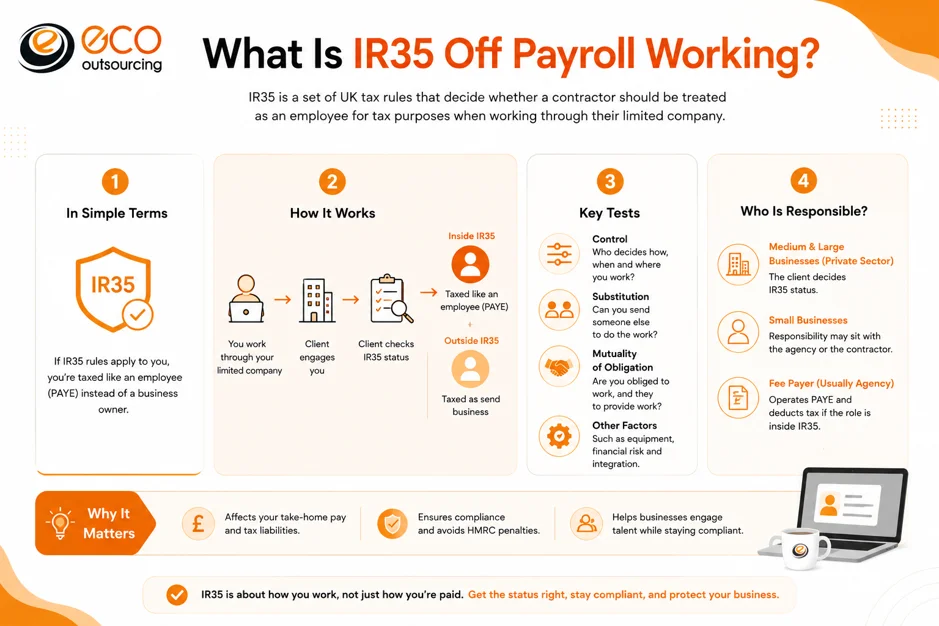
IR35 off payroll rules decide if a worker should pay tax like an employee. HMRC brought them in to stop people using a limited firm to pay less tax when they were really working as a hidden staff member.
The rules do not ban working as a contractor. They just say: if it looks like a job, it gets taxed like one.
Understanding the IR35 Off Payroll Working Rules
Since April 2021, the IR35 off payroll working rules put the duty to assess on medium and large end clients, not on the worker. The client checks each role and sends out a Status Determination Statement (SDS).
Small firms are still exempt. In those cases, the worker does their own check.
Inside vs Outside IR35
Outside IR35: You run through your limited firm. You pay corporation tax and draw dividends as usual.
Inside IR35: The fee-payer takes PAYE tax and NI before paying you. Your take-home drops a lot.
How IR35 Affects Contractor Take-Home Pay
On a day rate of £500, a worker outside IR35 keeps far more than one inside it.
Employer NI, employee NI, and PAYE tax all come out of your gross rate before you see it. That is why so many workers feel hard done by. You lose the tax benefits. But you gain no staff rights in return.
Key Subcontractor Status Tests
HMRC runs three main subcontractor status tests to set your IR35 position:
- Substitution: Can you send someone else to do the work?
- Control: Does the client say how, when, and where you work?
- Mutuality of obligation: Must both sides keep on offering and taking work?
Other things count too. Who bears the money risk? Whose tools are used? How tied are you to that one client?
What Happens After a Contract Is Determined Inside IR35?
Understanding the Status Determination Statement (SDS)
Once the end client makes their call, they must give you an SDS. This sets out whether your role is inside or outside IR35. It has to explain why.
No valid SDS? HMRC can go after the end client for any tax that was not paid.
Who Processes Payroll?
Under IR35 off payroll rules, the fee-payer sits at the bottom of the chain. That is almost always the agency. If there is no agency, it falls to the end client.
They run payroll, make all the right deductions, and report earnings to HMRC. If your agency needs support keeping that process clean and consistent,UK payroll management services can take on that responsibility end to end.
Payroll Deductions Contractors Should Expect
Here is a plain example. Day rate of £450 over 20 days:
| Item | Amount |
|---|---|
| Gross contract value (20 days) | £9,000 |
| Less: Employer NI (approx 13.8%) | -£1,059 |
| Less: Apprenticeship Levy (0.5%) | -£45 |
| Deemed employment income | £7,896 |
| Less: PAYE income tax (approx 20-40%) | -£1,974 |
| Less: Employee NI (approx 8-12%) | -£710 |
| Net take-home (approx) | £5,212 |
Your real figures depend on your tax code, income level, and the umbrella fee you pay.
Employer National Insurance Implications
This is the bit that hits hardest. The employer NI cost (13.8%) comes out of your rate, not on top of it.
So, you cover a cost the end client would have paid for a direct staff member. It is legal. But it takes a big chunk out of your pay. Factor it in when you talk rates.
Understanding Your IR35 Payroll Solution Options
Umbrella Companies
An umbrella firm takes you on as an employee. You log your hours, they bill the agency, and they pay you after taking all deductions. This is the most used IR35 payroll solution for inside IR35 workers.
PAYE Payroll Providers
Some agencies run their own PAYE payroll. You go onto their books as a temp worker. Less complex than an umbrella, but you have less freedom too.
Managed Contractor Payroll Services
Specialist IR35 contractor payroll services take on the whole job for agencies or end clients. They handle deductions, reports, and HMRC filings all in one place. This is where a dedicated payroll outsourcing service adds real value, removing the manual burden and reducing the risk of costly errors.
Agency Payroll Arrangements
Agencies can run agency payroll in-house as well. This works if they have the right tools and processes to stay on the right side of the rules.
Which Payroll Solution Is Right for You?
Locked in with one agency long term? Direct PAYE may suit you better. Compare the full cost and check who is accredited before you sign. For a full breakdown of what payroll outsourcing costs in the UK, see our payroll outsourcing cost guide.
Umbrella Company Payroll Explained
How Umbrella Companies Work
The umbrella firm sits between you and the agency. They take you on as staff. The agency pays them your gross. They make all the deductions and pay you what is left.
They also sort employer NI, auto-enrolment pension, and holiday pay on your behalf.
Understanding Umbrella Company Fees
Most firms charge between £15 and £30 a week. Some use a flat monthly rate. Umbrella firm fees must be clear and shown on each payslip.
If an umbrella charges a cut of your earnings, walk away. That is always a bad sign.
Understanding IR35 Umbrella Costs
Know what these add up to before you start. It puts you in a much stronger spot when you talk day rates. If you are comparing your options, our guide on how to outsource payroll in the UK walks through the vendor selection process step by step.
Contractor Payslip Requirements
Every payslip must list all deductions. Payslip rules for contractors under HMRC mean you need to see:
- Gross pay before any deductions
- Employer NI taken out
- Employee NI taken out
- PAYE income tax taken out
- Apprenticeship levy (if it applies)
- Umbrella fee
- Net pay
Anything missing? Get on to your umbrella firm right away.
How to Switch Umbrella Companies
You can switch umbrella firms at any point. Give the notice your contract asks for. Tell the agency your new firm’s details. Lock in the date the switch happens.
Make sure there is no gap in your payroll. Some agencies have a set list of approved firms, so ask first.
Warning Signs of a Non-Compliant Umbrella Company
- Promises of take-home above 85% of your rate
- Loans, advances, or credit deals instead of a normal wage
- Vague or missing lines on your payslip
- Not signed up with HMRC or the FCSA
- Pressure to sign fast, with no proper explanation
Umbrella vs Limited Company
The choice between umbrella vs limited company comes down to your work pattern, your risk level, and your IR35 status.
| Factor | Umbrella Firm | Limited Company (Outside IR35) |
|---|---|---|
| Tax outcome | Lower take-home via PAYE | More take-home via dividends |
| Admin work | Low, the umbrella handles it | High, you need an accountant |
| IR35 risk | None, you are already on PAYE | You or the client holds the risk |
| Staff rights | Holiday pay, pension, sick pay | None by default |
| Freedom | Move between roles with ease | More cost to open and close |
| Fee | Set weekly or monthly charge | Accountant and filing costs |
If most of your roles land inside IR35, an umbrella is the simpler and safer path. Win outside IR35 work often? A limited firm will put more money in your pocket.
Payroll Compliance Checklist for Contractors
Reviewing Payroll Deductions
Go through your payslip every time you get paid. Check each line. Make sure what was agreed matches what was taken.
Also confirm your tax code is right. A wrong code means you either overpay or underpay. Both cause problems later.
Checking Payslips
A contractor payslip must arrive on or before payday. It must show every deduction in full.
Get a vague summary sheet instead of a proper payslip? Raise it with your umbrella or agency the same day.
Payroll Processing Timelines
Payroll timelines vary. Most umbrella firms run weekly or monthly cycles.
Miss your timesheet cut-off and your pay could slip to the next cycle. Agree the deadline with your umbrella. Then hit it every time.
Record Keeping Requirements
IR35 record keeping means you hold on to your SDS, contracts, payslips, and all emails or letters with agencies and clients.
HMRC can look back six years. Keep your files for at least that long.
Preparing for HMRC Reviews
| Action | Why It Matters |
|---|---|
| Keep all payslips and P60s | Proves the right tax was paid |
| Keep your SDS and any appeal letters | Shows you followed the off-payroll rules |
| Write down how you actually work | Backs up an outside IR35 case |
| Hold on to invoices and timesheets | Confirms your payment trail |
| Note any contract changes | Shows genuine outside IR35 terms |
Agency Payroll Responsibilities and Liability Risks
Responsibilities of Agencies
As fee-payer, agencies carry big payroll duties. They must deduct PAYE and NI, pay employer NI, report pay to HMRC via RTI, and pass the SDS from the end client down to the worker.
Responsibilities of End Clients
End clients must check IR35 status, issue a valid SDS, and pass it down the chain. Skip that step and HMRC can hold them liable for any tax and NI that was missed.
Understanding Off Payroll Liability Risks
Off payroll liability risks can move along the chain. If an agency knew a call was wrong and did nothing, HMRC can push the bill to them. Same goes if the end client hid or held back the SDS.
Payroll Outsourcing Risks Contractors and Agencies Should Know
| Party | Risk | How to Cut It |
|---|---|---|
| Contractor | Using a non-compliant umbrella | Check FCSA or PRISM membership |
| Agency | Wrong NI amounts deducted | Use proper IR35 payroll software |
| End Client | No valid SDS sent out | Run the CEST tool and log it |
| Agency | Liability moved from the client | Get the SDS in writing first |
| Contractor | Tax shortfall via loan schemes | Reject any odd pay set-up |
For agencies that want a cleaner approach to all of this, outsourcing payroll to a specialist UK provider removes most of these risks from your in-house team.
How to Challenge an IR35 Determination
When Can You Appeal?
You can push back on an SDS if you think it is wrong. Write to the end client with your case. This is called the client-led disagreement process.
Evidence Required
You need real proof. Bring your contract, notes on how you work day to day, evidence you have sent a substitute, proof you carry money risk, and any other facts that back up an outside IR35 case.
Understanding the IR35 Appeal Timeline
The IR35 appeal timeline gives the end client 45 days to reply. They must either change the call or give clear reasons for keeping it.
Miss the 45-day mark and they lose the right to rely on the original SDS for shifting liability.
What Happens After an Appeal?
- Write to the end client. Set out your case and attach your proof.
- They review it and must reply within 45 days.
- Still not happy? Use HMRC’s Check Employment Status for Tax (CEST) tool to escalate.
- HMRC agrees with you? The call changes. If not, get specialist tax advice.
Payroll Penalties and Common Compliance Mistakes
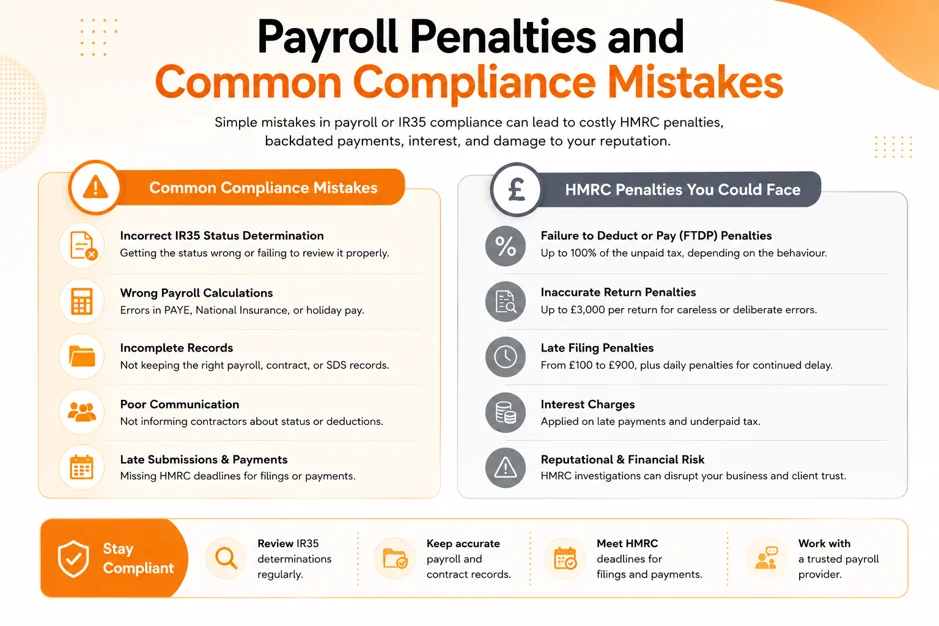
Common Payroll Errors
The most common triggers for HMRC payroll penalties are missed RTI filings, wrong tax codes, no SDS passed on, and using umbrella firms that are not up to standard. Read our breakdown of the pros and cons of outsourcing payroll in the UK to understand where in-house management creates the most exposure.
Payroll Penalties HMRC May Apply
- Late or missing RTI filing: £100 to £400 per month
- Wrong NI deductions: interest plus penalties up to 100% of what was owed
- No SDS issued: liability shifts to the end client
- Using a hidden pay scheme: loan charge with backdated tax
Mistakes Contractors Should Avoid
- Taking home above 85% of your rate without asking why
- Not reading your payslip each month
- Trusting an umbrella just because your agency told you to
- Failing to keep records for at least six years
Mistakes Agencies Should Avoid
- Running payroll without a valid SDS
- Using software that cannot handle off-payroll maths
- Not checking whether your listed umbrella firms are accredited
- Thinking the liability chain cannot reach you
Choosing the Right IR35 Payroll Partner
What to Look for in an IR35 Payroll Company
A good IR35 payroll firm will be FCSA or PRISM accredited. They show every deduction on your payslip. Their staff know the rules. And they use IR35 payroll software that handles RTI, NI, and PAYE correctly, in real time. Our guide on how to choose a payroll outsourcing provider has a 10-point vendor checklist you can use to vet any firm before you sign.
Questions to Ask Before Outsourcing Payroll
- Are you FCSA or PRISM accredited?
- How do you handle SDS documents?
- What payroll software do you use?
- Do you hold professional indemnity cover?
- Can you give me references from workers in my field?
Why Payroll Compliance Support Matters
The right IR35 payroll solutions provider saves you more than time. It keeps HMRC off your back, gets your deductions right, and stops a big tax bill landing out of nowhere months later. Firms that want that kind of support without the overhead of building it in-house often turn to managed payroll outsourcing.
Frequently Asked Questions
Inside IR35, you are taxed like a staff member. PAYE tax, employee NI, and employer NI all come out of your rate before you are paid. You lose the right to take dividends through a limited firm.
If your role is inside IR35, an umbrella firm is normally the most practical route. They handle all deductions for a flat fee. Always check they are FCSA or PRISM accredited before you sign.
Most charge between £15 and £30 a week. Avoid any firm that takes a cut of your pay or promises very high take-home figures.
You should see gross pay, employer NI, employee NI, PAYE tax, the levy, your umbrella fee, and net pay. Missing a line? Contact your provider that day.
Yes. Write to the end client with your evidence. They have 45 days to reply. They must either revise the call or give clear reasons for keeping it.
Conclusion:
Where you go from here depends on your position.
You are a contractor inside IR35: Check your payslip today. Go line by line. Is your umbrella FCSA or PRISM accredited? If any line looks off, write it up. Do not let it slide.
You are choosing between payroll options: Look at the full cost, not just the weekly fee. Add employer NI, the levy, and pension on top. Ask each firm for a take-home figure based on your actual rate.
You are worried about compliance: Start with your files. Do you have your SDS, contracts, and six years of payslips? If there are gaps, get a review done before HMRC asks the same question.
You run an agency and manage contractor payroll: Audit your chain now. Check every umbrella firm you use is accredited. Do you have a valid SDS for every inside IR35 role? Gaps mean real risk. If the process is getting too complex to manage in-house, see how business process outsourcing can take the compliance burden off your team.
Need help with IR35 payroll compliance?
Eco Outsourcing helps workers, agencies, and firms across the UK. We cut HMRC risk, sort your payroll, and make sure your deductions are right each time.
Get in touch today to find out how we can help with your IR35 payroll needs.