
Managing a team feels rewarding, but admin work takes time. Payroll is often the biggest drain on resources. A small error or delay can trigger HMRC penalties. That risk adds pressure every pay cycle.
This guide explains how to outsource payroll in a simple way. It helps you save time and stay compliant.
What Does It Mean to Outsource Payroll in the UK
To outsource payroll UK, you hire a specialist to manage payroll tasks. The provider calculates pay, handles deductions, and submits reports to HMRC.
They manage the process, but you keep legal responsibility. You supply the data. They apply the expertise.
What Payroll Outsourcing Usually Includes
Most providers offer these core services:
- Calculate wages, bonuses, and overtime
- Deduct tax and National Insurance
- Manage pension auto-enrolment contributions
- Issue secure digital payslips
- Submit Real Time Information (RTI) to HMRC
This setup reduces manual work and lowers the risk of errors.
When to Outsource Payroll and When to Keep It In-House
Deciding how to choose payroll provider starts with evaluating your current workload. Small teams may manage with basic software, but growth adds complexity.
Signs you should outsource
- You spend more than two days a month on admin.
- You struggle to keep up with changing UK tax laws.
- Your staff headcount is growing rapidly.
- You have high turnover or varied shift patterns.
When not to outsource
- You have a dedicated, qualified in-house payroll team.
- Your payroll is extremely simple with one or two fixed-salary staff.
- You have highly sensitive data requirements that must stay on-site.
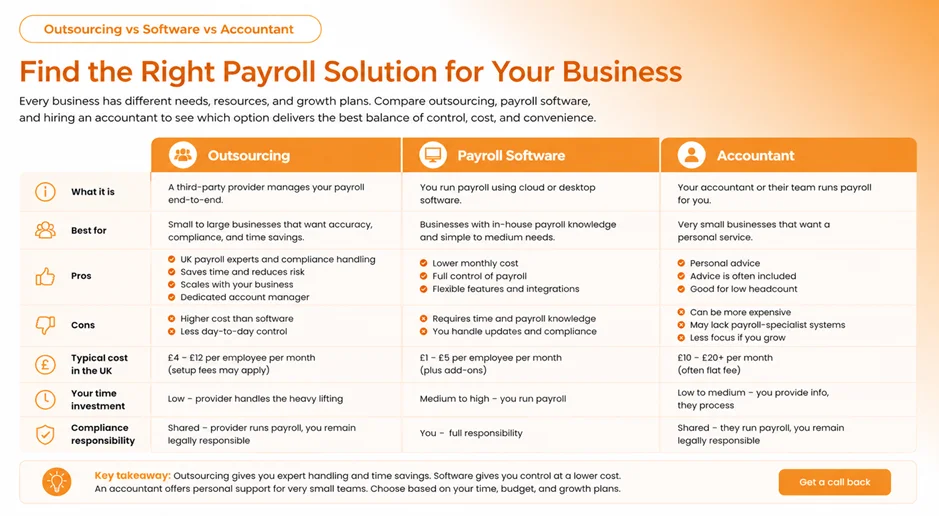
Outsourcing vs software vs accountant
Payroll software requires you to be the expert. An accountant might offer payroll as a side service, but they may lack specialized software. A dedicated payroll bureau offers the highest level of niche expertise and robust payroll compliance requirements support.
UK Payroll Compliance Requirements Explained Simply
UK payroll is governed by strict HMRC rules. Failure to follow them results in “failure to notify” penalties or late payment interest.
PAYE basics
Pay As You Earn (PAYE) is the system HMRC uses to collect Income Tax and National Insurance. Your provider ensures the correct tax codes are applied to every employee.
RTI submissions
Under Real-Time Information (RTI), you must send a Full Payment Submission (FPS) to HMRC on or before every payday. This tells HMRC exactly what you paid your staff.
Pensions and statutory payments
Employers must manage workplace pension contributions. You also need to calculate Statutory Sick Pay (SSP), Maternity Pay (SMP), and Paternity Pay (SPP) accurately.
Employer responsibility
Even when you outsource payroll, HMRC holds the employer liable for errors. You must ensure your provider is competent and that you provide them with accurate data on time.
Risks of Outsourcing Payroll in the UK
While beneficial, there are payroll outsourcing risks UK businesses must manage.
Who is responsible for errors
The employer is legally responsible for HMRC fines. If your provider makes a mistake, you pay the fine first, then seek a refund from the provider based on your contract.
Common risks
- Data Breaches: Handling sensitive employee bank details carries GDPR risks.
- Communication Gaps: Late data submission leads to late payments.
- Hidden Costs: Some providers charge extra for basic tasks like P45 generation.
How to reduce risks
Always conduct thorough payroll provider due diligence. Check for ISO certifications and professional indemnity insurance. Use secure cloud portals for data transfer rather than email.
Payroll Outsourcing Costs in the UK
Understanding payroll provider costs in the UK helps you budget effectively. Most providers use transparent pricing, but you must look for the extras.
Pricing models
- Per payslip: Usually £2 to £6 per employee, per month.
- Fixed monthly fee: A flat rate for a set number of employees.
- Annual base fee: A setup or standing charge plus a variable rate.
Hidden fees
Watch out for payroll provider hidden fees such as:
- Setup or onboarding charges.
- Fees for P45s or P60s.
- Charges for pension mid-period entries.
- Fees for re-running payroll due to your errors.
Cost factors
Complexity drives price. If you have multiple pension schemes, varying commissions, or weekly pay cycles, expect higher costs.
How to Choose a Payroll Provider in the UK
Picking a payroll provider is not just about price. You need a service that works with your systems and follows UK rules. A clear how to choose payroll provider approach helps you avoid issues later.
Key Criteria to Check
Look at the basics that affect daily work and long-term use:
- UK support: The provider should understand local payroll laws
- System fit: Make sure it connects with your HR or accounts software
- Security: Check for MFA, encryption, and secure logins
- Flexibility: The service should grow with your business
Payroll Provider Due Diligence Checklist
Use this quick payroll provider due diligence list before you decide:
- Check if they are registered with the Information Commissioner’s Office (ICO)
- Review their insurance cover for payroll errors
- Read real customer feedback on Trustpilot or similar sites
- Confirm they act as a registered HMRC agent
- Ask how they protect and store payroll data
Questions to Ask Before You Decide
Ask simple questions to avoid surprises:
- Can you run payroll quickly if needed?
- How fast do you reply to support queries?
- Do you charge extra for year-end reports?
- Will I deal with one account manager?
Clear answers make it easier to compare providers and choose the right fit.
Payroll Vendor Selection Checklist
Use this payroll vendor selection steps list to narrow your search:
- Define your specific payroll frequency (weekly, fortnightly, monthly).
- Identify necessary integrations (Xero, Sage, BambooHR).
- Set a clear budget for “per-head” costs.
- Confirm the provider handles auto-enrolment and pension uploads.
- Check for a secure employee self-service portal.
- Verify their disaster recovery plan.
8-Step Process to Outsource Payroll in the UK
Follow these payroll service onboarding steps for a seamless transition.
- Audit Current Data: Clean up your existing employee records and tax codes.
- Define Requirements: List exactly what you need (pensions, CIS, bonuses).
- Shortlist Vendors: Compare three providers based on your payroll onboarding checklist.
- Review the Contract: Pay attention to notice periods and liability clauses.
- Assign a Project Lead: Have one person in your office manage the switch.
- Set Up Systems: Establish the secure data transfer method.
- Run Parallel Payroll: Process one month in-house and with the vendor to check for discrepancies.
- Go Live: Officially switch all submissions to the new provider.
Payroll Onboarding Process in the UK
The payroll onboarding process in UK is the most critical phase. If data is wrong here, every subsequent month will be wrong.
Required documents
Gather all payroll documentation required early:
- Company HMRC reference numbers (PAYE and Accounts Office reference).
- Employee P45s or New Starter Checklists.
- Current Year-to-Date (YTD) figures.
- Pension provider details and contribution rates.
Data migration
Your new provider will import your data into their system. Accurate “Opening Balances” are essential to ensure employees don’t overpay tax.
Testing phase
Run a test payroll first. This helps you spot issues with bank file formats or pension calculations before any real payments are made.
Timeline
A standard payroll provider timeline in UK usually takes 4 to 8 weeks. Do not rush this process.
Payroll Provider Contract Checklist
The contract protects your business. Use this payroll provider contract checklist before signing:
- Service Level Agreement (SLA): Defines response times and accuracy guarantees.
- Data Protection: Must be fully GDPR compliant.
- Termination Clause: Usually, 30 to 90 days’ notice.
- Liability Limits: Ensure they are covered for their own errors.
- Red flags: Watch for long-term “lock-in” periods or vague “extra work” fees.
Payroll Provider Timeline in the UK
Most setups follow a clear payroll provider timeline. This helps you plan each step with confidence.
Week 1:
Start with a consultation. Review scope and sign the contract.
Week 2:
Share employee data. Set up secure access and user accounts.
Week 3–4:
Enter data and configure the payroll system. Check basic settings.
Week 5:
Run a parallel payroll. Compare results and fix any errors.
Week 6:
Approve final data. Prepare for the first live payroll run.
A structured payroll onboarding process reduces delays and errors.
Common Mistakes to Avoid
Avoid these common issues when you outsource payroll in the UK:
- Waiting for April: You can switch providers at any time
- Ignoring pensions: Ensure full pension processing, not just calculations
- Poor data quality: Clean data speeds up onboarding and reduces errors
- Skipping checks: Always review references and past client feedback
A simple payroll outsourcing checklist helps you stay on track and avoid costly mistakes
What Happens After You Outsource Payroll
Once the payroll onboarding process is complete, your monthly workload drops significantly. You will simply upload a “changes file” each month (new starters, leavers, overtime). The provider handles the rest. You will receive a summary report to approve, and they will distribute payslips and file HMRC reports.
How Eco Outsourcing Supports Your Payroll
Eco Outsourcing helps you run payroll with less effort and fewer risks. The focus stays on accuracy, compliance, and clear updates at every stage.
- UK payroll expertise aligned with HMRC rules
- Secure systems with strong data protection controls
- Clear pricing with no hidden fees
- Guided payroll onboarding process UK from start to finish
- Ongoing support to keep payroll accurate and on time
This makes it easier to outsource payroll UK without delays or confusion.
Conclusion
Outsourcing payroll saves time and reduces costly errors. It also helps you meet UK compliance rules with confidence.
Choose a provider with care. Check costs, run payroll provider due diligence, and plan onboarding in clear steps. Test runs and regular checks improve accuracy.
When set up well, payroll runs each cycle smoothly. You gain time to focus on growth while payroll stays consistent in the background.
Frequently Asked Questions
Payroll outsourcing is when you pass payroll tasks to a specialist. They handle pay runs, submit RTI to HMRC, and manage pensions. You provide employee details, approve each run, and check reports. You still carry legal responsibility for accuracy.
Start by listing what you need now and next year. Look at UK compliance experience, support access, and system fit. Check pricing, SLAs, and integrations. Speak to current clients. A clear how to choose payroll provider approach lowers risk.
Use simple payroll vendor selection steps:
Run tests, then go live
Set scope and payroll needs
Shortlists outsource payroll UK providers
Compare costs and terms
Complete payroll provider due diligence
Agree SLA and sign contract
Start payroll onboarding process
Most payroll provider costs UK fall between £4 and £12 per employee each month. Some charge setup fees. Check for year-end work, changes, and exit fees. Price depends on team size and pay cycles.
A provider must handle payroll compliance requirements such as PAYE, RTI, and pensions. They should follow HMRC rules and GDPR. You should still review outputs and keep records accurate.
Ask where data is stored and how it is protected. Check encryption, access control, and backup plans. Confirm GDPR processes and breach steps. Add these checks to your payroll provider contract checklist.
Prepare the main payroll documentation required:
- Employee details and contracts
- PAYE reference and tax codes
- Recent payroll reports
- Pension scheme data
Clean data helps avoid setup issues.
The payroll provider timeline in UK is often two to six weeks. This covers data transfer, setup, and testing. Complex payrolls may take longer.
Common payroll outsourcing risks include errors, delays, and data gaps. Reduce risk with clear SLAs, test runs, and regular checks. Choose a provider with strong UK experience.
Yes. Most providers manage enrolment, contributions, and reports. Confirm this in your scope. Ask how they handle re-enrolment and notices.
Plan the move in stages. Export clean data and map fields. Run a parallel payroll to check results. Switch at period end. A solid payroll onboarding process in UK keeps things smooth.
Set clear timelines, accuracy targets, and response times. Include the fixed windows and penalties. Add uptime and data security terms. Use a detailed payroll provider contract checklist.
Most connect to accounting and HR tools through APIs or file uploads. Check which systems they support and how often data syncs. Good links reduce manual work.
Some choose based on price alone. Others skip checks or rush setup. Many ignore contract terms. Use a payroll outsourcing checklist to stay on track.
Track hours saved, error rates, and compliance issues. Compare total costs before and after. Review report quality and support speed. Clear KPIs show if outsourcing payroll adds value.