

Introduction
Holiday pay is easily one of the most confusing parts of running a UK business right now. The basic rules look simple on paper, but doing the math is where things get messy, especially for staff with shifting hours or commission.
It’s very easy to make a mistake, and those errors get expensive fast if you have to pay everyone back. This isn’t a legal book. It’s a practical guide for anyone running payroll who wants to get things right without digging through court cases.
If you want to keep your business safe and your staff paid fairly, here is exactly what you need to do.
UK Holiday Entitlement: What You Actually Need to Know
The Basic Statutory Rules
The “official” rules for UK holiday time haven’t really shifted for 2026, but let’s be honest: the way we actually have to manage them is getting way more complicated. Look, almost every worker is still owed 5.6 weeks of paid leave. If someone’s in the office five days a week, that usually equals 28 days. But you can’t just fixate that “28 days” figure. It’s a total trap because it doesn’t work the same way for everyone on your payroll.
Two things catch employers out early. First, the distinction between an “employee” and a “worker.” Someone on a casual or short-term arrangement still usually qualifies as a worker and is entitled to statutory leave. Second, bank holidays.
If your contracts do not clearly state whether bank holidays sit inside that 5.6 weeks or on top of it, you may owe more leave than you have budgeted for.
Contractual vs. Statutory Leave
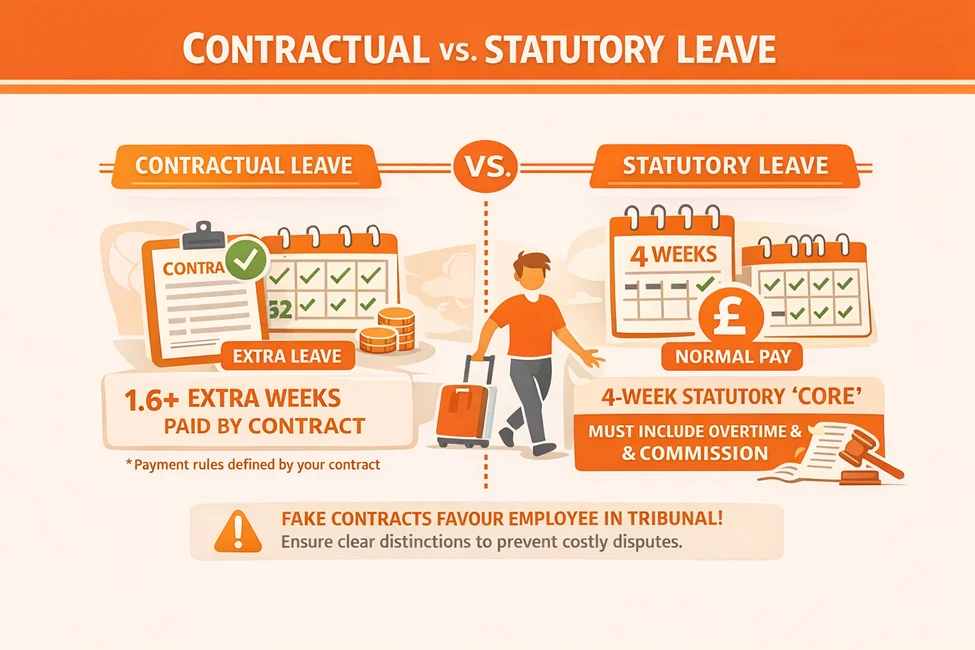
Offering more than the legal minimum is common, and it is fine to do. But you need to track contractual and statutory leave separately in your system, because the payment rules are different.
The first four weeks of leave, the statutory “core,” must be paid at the worker’s normal rate including overtime and commission. The remaining 1.6 weeks and any extra contractual days can sometimes be paid differently, but only if your contract is specific about it.
Fake contracts almost always favour the employee at a tribunal, so clarity now costs nothing compared to what ambiguity costs later.
Holiday Pay Calculations: The Mistakes That Lead to Claims
What “Normal Pay” Means
Paying basic salary during a holiday is the most common and most expensive mistake in UK payroll right now. The legal standard is “normal remuneration,” which means what the worker would have taken home had they been at work.
You must include:
- Regular overtime, whether guaranteed or not.
- Commission payments.
- Performance-related bonuses.
- Shift allowances and standby pay.
A salesperson on a £30,000 basic who regularly takes home £50,000 including commission must have their holiday pay calculated on the £50,000 average. Paying the basic is underpayment, and workers are increasingly aware of it.
The 52-Week Reference Period
For any worker with variable pay or hours, you must look back at the last 52 weeks in which they received pay. Weeks with zero earnings are skipped. You go further back until you have 52 paid weeks.
Weekly average:
Total gross pay across 52 paid weeks / 52 = Average weekly holiday pay.
Daily rate:
Average weekly holiday pay / Days usually worked per week = Daily holiday rate.
Overtime Is Not Optional to Include
Courts have been clear on this for years. If overtime is worked regularly and forms part of someone’s normal earnings, it goes into the holiday calculation. The argument that “voluntary” overtime can be excluded has largely failed in case law.
More employees now compare their holiday pay slips to their normal working pay slips. When the figures do not match, that is what triggers a formal dispute. If you are unsure whether your current process handles this correctly, it is worth reviewing how your outsourced payroll is set up before a problem surfaces.
Holiday Accrual by Worker Type
Permanent Full-Time Staff
Grant the full year’s entitlement at the start of the holiday year. Clean, simple, no accrual calculation needed.
Irregular-Hours and Part-Year Workers
For anyone whose hours shift week to week, the 12.07% method is the most practical compliant approach. It ties holiday directly to hours worked.
Formula:
Total hours worked in pay period x 0.1207 = Accrued holiday hours.
New Starters
Entitlement is pro-rated based on the months remaining in your holiday year. Someone joining three months in gets 75% of the annual entitlement. Set their opening balance correctly from day one and make sure they know how to book leave and how their accrual works.
Leavers
The final pay run must reconcile the leaver’s holiday balance. If they have taken more than they earned and the contract allows a deduction, you can make it. If they have unused days, you must pay them out. This is the only situation where paying out holiday instead of taking it is legal.
Getting this wrong is one of the most reliable ways to receive a legal letter after someone leaves. Treat the final pay slip carefully. If your internal team is stretched at month-end, outsourced HR support can handle leaver processing cleanly without it falling through the cracks.
Part-Time and Zero-Hours Workers
Part-time entitlement is calculated on a pro-rata basis. Two days per week means 11.2 days of leave.
Zero-hours staff need either the accrual method or the 52-week average because their hours are never fixed. Skipping this step leads to underpayment and a claim, or overpayment and a loss. Neither outcome is good.
Carry Over, Sick Leave, and the Rules People Miss
Carry Over
The general rule is that workers use their leave in the year it is earned. But if someone could not take leave because of long-term sickness or maternity leave, they have a legal right to carry it over.
A “use it or lose it” rule only holds if you have genuinely given the employee the chance to take their leave and warned them in writing that they would lose it if they did not. Deleting a balance at year-end without that process is not enforceable.
Sickness and Holiday
Holiday keeps accruing during sick leave. You cannot pause it because someone is on Statutory Sick Pay. If an employee falls ill during a holiday, they can ask for those days to be rerecorded as sick leave and take the holiday at another time. It feels frustrating, but it is the law and tribunals uphold it consistently. Payroll Processing, Tax, and Pensions Holidays
System Integration
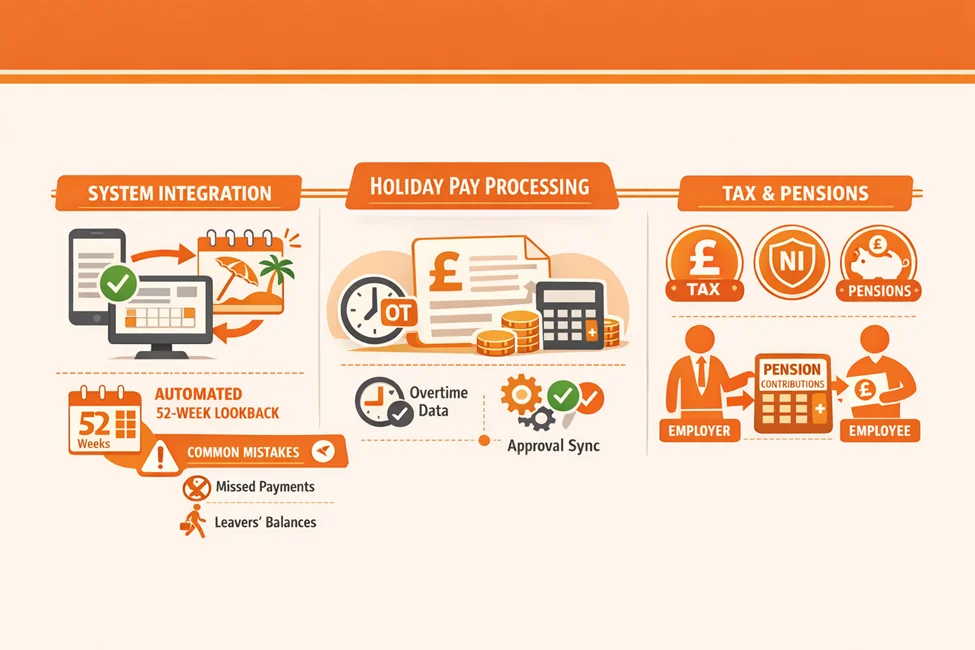
The most significant source of “human error” is when your HR and payroll systems don’t talk to each other. Holiday pay payroll integration is vital. If a manager approves a holiday in an app, but the payroll person doesn’t see the overtime data needed for the calculation, you’re going to have a mistake. In 2026, automation should be doing the heavy lifting of the 52-week look-back.
Tax, National Insurance, and Pensions
Holiday pay is wages. It attracts income tax and National Insurance the same as any other pay. It is also pensionable. If you pay out a holiday balance at the end of a contract, both employer and employee pension contributions must be calculated on it. This step is regularly missed, especially for leavers.
Record-Keeping: What You Need and for How Long
What to Store
You need to be able to produce all of the following if a dispute or compliance check comes up:
- Hours worked each week.
- Confirmation that leave was taken on the dates recorded.
- The 52-week dataset used for every variable-pay calculation.
- Any written carry-over agreements.
How Long to Keep It
Tribunal claims for unlawful deductions can cover two years of back-pay. Keep leave records for at least six years. The storage cost is minimal. The cost of not having the records when you need them is not.
Risks, Penalties, and Handling Disputes
The Errors Still Showing Up in 2026
Using a 12-week average instead of 52 weeks is still the most common compliance gap. If your process or software has not been updated, you are already out of step with the law.
The other one is paying “payment in lieu” of holiday to a current employee. This is only legal on termination. You cannot pay someone extra to skip their leave while they are still employed.
What It Actually Costs to Get It Wrong
Tribunals award back-pay for a “series of deductions” going back two years. Fifty employees each underpaid by £100 is a £5,000 liability before legal fees. Where the tribunal decides underpayment was deliberate, additional fines apply on top of that.
When an Employee Raises a Dispute
Pull the 52-week data. Check whether any overtime or commission was left out. If there is an error, correct it in the next pay run and be upfront about what happened. A straightforward correction costs a fraction of what legal escalation costs. Defensiveness helps no one.
The 2026 Payroll Holiday Checklist
Every Month
Entitlement review. Check if anyone has changed their contract hours. A part-timer going full-time needs their leave balance updated straight away.
Accrual check. For zero-hours staff, run the accrual calculation based on actual hours worked in the period.
Variable pay audit. Anyone taking leave who has earned commission or overtime in the past year must have their holiday pay calculated using the 52-week average, not basic pay.
Documentation. Save all holiday requests and approvals with clear dates in your record-keeping system.
Every Time Someone Starts or Leaves
Opening balance. Set the new starter’s leave balance based on the months remaining in the holiday year.
Onboarding information. New staff need to know how to book leave and how their accrual works from day one.
Termination reconciliation. Compare earned leave against taken leave and calculate the difference accurately before the final pay run.
Final pay slip check. Holiday pay on termination must be clearly itemized. It affects tax and pension calculations and must be visible.
Every Year-End
Balance reminder. Send a written notice to all staff with remaining leave, stating what happens to unused days and the deadline to use them.
Contract review. Confirm the statutory and contractual leave split is still clearly defined and legally sound.
Software check. Test that overtime and commission are feeding into the 52-week average calculation automatically. If they are not, fix it before the next pay run.
Records archive. Store the year’s leave records somewhere they can be retrieved quickly if needed.
Risk scan. Check across all variable-pay employees for any pattern of underpayment before it becomes a formal claim.
When Holiday Pay Must Be Paid
Holiday pay must land in the same pay period as the leave. Two weeks off in June means the payment goes in the June pay slip, not July. You cannot defer it.
For leavers, any outstanding holiday pay must be in the final pay run. Delaying it to a later month is a breach of contract and an unlawful wage deduction.
How Eco Outsourcing Helps Employers Stay Compliant
Staying on top of statutory holiday pay while running a business is exhausting. The rules change, the case law evolves, and the math gets complicated. This is where a specialist partner makes a difference.
At Eco Outsourcing, we live and breathe holiday pay payroll integration. We don’t just process pay slips; we ensure your calculations are audit-proof. We manage the 52-week reference periods, track the holiday accrual calculation for your zero-hours staff, and ensure your holiday pay tax NIC treatment is flawless.
Our goal is to take the “compliance anxiety” off your plate so you can focus on your core business.
Conclusion
Most holiday pay mistakes are pretty simple. They usually happen because of out-of-date software, or confusing contracts. To stay safe, you just need to do three things: use the 52 week average, include overtime and commission, and keep clear records.
If you run these checks regularly and update your process whenever someone’s pay changes, you’ll stay out of trouble. It’s much better to get it right now than to face a huge bill for unpaid wages later on.
Frequently Asked Questions
Yes. If they usually bank that money when they’re working, you have to pay it when they’re on the beach…If you only pay their basic salary and ignore the commission or regular overtime they rely on, you’re underpaying them and asking for a legal headache.
No. You can’t just buy their holiday off them to keep them at their desks. The law is strict about them getting actual physical rest.
They’re allowed to call in sick and “save” their holiday days for later. It’s annoying for your rota, but the rules say holiday is for rest, and being ill doesn’t count.
On their last day, you need to settle the balance. If they have days left over, pay them out in their final packet.
You can, but you can’t be sneaky about it. You can’t just wipe their balance at midnight on December 31st if you never gave them a chance to book the time.
It’s exactly the same as a normal day’s work. The taxman still takes his slice, so you deduct Income Tax and National Insurance as usual.